Showing posts with label Joseph Mitchell. Show all posts

Wednesday, June 29, 2011

East 1st Street between 2nd Avenue and the Bowery

The Mars Bar building in the 1910s as the Woolworth Theatre.
The new glass box that stands at the Bowery and E. 1st St. today.

A New York Times article from the 1870s.
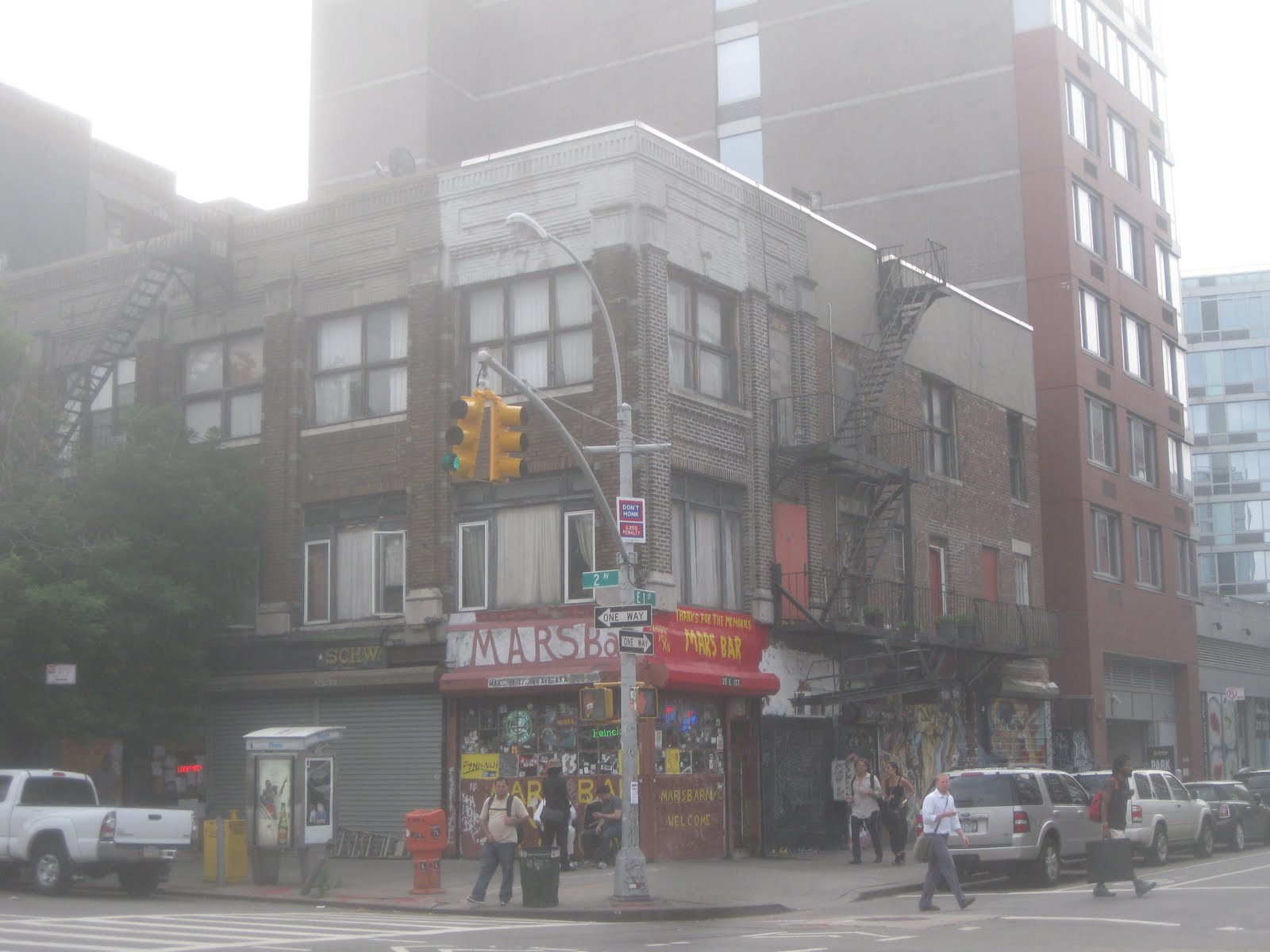
Mars Bar in June 2011.
Another shot of Mars Bar in its final days.
Extra Place in June 2011, undergoing some renovations
The Mars Bar building sat empty toward the end of Prohibition.
Mars Bar in the '40s as a coffee, tea, and spices shop.
295 Bowery, formerly McGurk's, in it's final days.
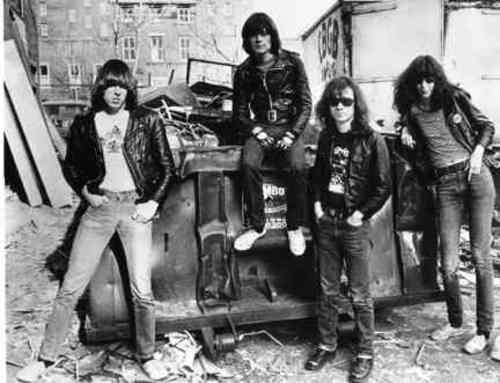
The Ramones pose on Extra Place behind CBGB in the early '70s.
Another description of Extra Place from 1952.
A description of Extra Place from 1952.
Extra Place in 1934.
An 1890s map of E. 1st St. includes "Extra Street".
Extra Place in 1978.
Around the Old-New-York-memory-lane-blogosphere these days, there's been a lot of talk about Extra Place and Mars Bar, old-rocker staples that are drastically changing or being torn down all together, years after beloved CBGB's is long gone. In 2005, historic McGurk's Suicide Hall on the Bowery and East 1st Street was demolished amid protest and replaced with a glass box, and now the same is going to happen with to the buildings on East 1st Street and 2nd Avenue. Anyone who wants to have one last beer at the diviest bar in the city, I read that this is the last week to do it.
Looking down East 1st Street from the Bowery in 2002.

Looking down East 1st Street from 2nd Avenue in 2002.
A close up of 291-295 Bowery, demolished in 2005.
No. 295 Bowery went up shortly after the Civil War ended, where it served as a political and social club for the mostly German community that inhabited the Lower East Side at the time. But throughout the latter half of the 19th Century, the Bowery became increasingly seedier. While the more upscale theatre district could be found on West 23rd Street around the Chelsea Hotel, a less desirable row of opera houses and dance halls lined the Bowery, catering to the poorer lower class. Drinking and prostitution were rampant, and it was common to find sailors and longshoremen frequenting the saloons along this thoroughfare. Back-room girls would hang around these places looking for business. John McGurk, an Irish immigrant who owned a number of saloons in the area, all shut down by police by the early 1890s, took over the bar and hotel at 295 Bowery and immediately started having run-ins with the law. He is said to have had the first bouncer in the city, who was regularly taken-in by police for assault. McGurk's quickly gained a reputation as the seediest, most dangerous hang-out in town, which is saying something for the Bowery. The prostitutes who ended up frequenting this place were very much down on their luck. In 1899, there were at least six suicides and seven attempts by back-room girls here. Some jumped out the windows up above while others drank carbolic acid. One story is of two harlots, Blonde Madge Davenport and Big Mame, who had made a pact to end it. They bought carbolic acid from the local drug store, and while Madge drank her share and suffered an agonizing death, Mame accidentally spilled most of it on her face, horribly disfiguring it. Because of this, she was banned from the bar and thrown out on the street, no longer able to do her job. To bank on his bar's morbid reputation, he renamed it "McGurk's Suicide Hall" in 1901. Unable to fight the constant police crackdowns and owing money to several people, he abandoned the place and fled to California a decade later with his wife and daughter. A final blow came shortly before his death when his daughter was denied admission to a convent school out in California when the nuns learned of the girl's father's history in New York.

In Joseph Mitchell's 1941 essay "A Sporting Man", he interviewed Commodore Dutch, a neighborhood eccentric who decades earlier had gotten his start working for McGurk, bringing sailors and longshoremen there on the weekends. In Mae West's 1932 book Diamond Lil, there's a chapter entitled "Suicide Hall", describing the place. In the 1960s, writer and sculpter Kate Millet and photographer and custom furniture maker Sophie Keir worked there. Despite some protest, the building was unable to get landmark recognition due to its unremarkable architecture and unfortunate if not colorful past, and was demolished in 2005. Next month, the remainder of the buildings that originally made up the German theatre and nightlife scene will be razed as well, and sad to say, I'm sure some giant, expensive, glass hotel will go up in it's place just like one did with McGurk's.

I'm a guy who likes an unpretentious, affordable bar just as much as anyone else, but the first time I took a peak inside Mars Bar, it was almost scary. Talk about a bunch of degenerates and druggies. My cousin who works at a hair salon nearby said she dated someone who loved the place, and there would be people passed out on the floor and in the bathroom. That's why some of the locals are glad to see it go. In a recent article I read, some bartenders said that that place took all the drunks who would be rejected any place else, so all they did was cause trouble. But the buildings that opened up as the Volksgarten and the Steuben House in the 1850's have certainly seen a lot. Called the German Assembly Rooms by the late 1800s, they housed saloons, bowling alleys, and ballrooms. Thanks to the Vanishing New York blog, I've found some great pics of the building: one during Prohibition when it was boarded up and available for lease, and another from the 1940s when it was a coffee, tea, and spices shop. It can also be seen in the opening credits of NYPD Blue (for about a second), and I've added a link. Down with it will also go the locksmith shop next store, whose owner I saw the last time I was down there, but unfortunately only saw him in an online magazine article about a week later.

The glass box on the sight of McGurk's is called "Avalon Bowery Place", and their next project is to turn the easily-missed, yet very-old "Extra Place" into the next yuppified strip-mall, filled with over-priced cafes and boutiques. I had ventured down there a couple of times to see some sort of cafe ready and open for business, tables and chairs out side, and a number of twenty-somethings enjoying the closed-off space and fresh air, but other than that, not too much. The last time I was on the block, it was closed off again -- I guess more gentrification is on its way. The alleyway dates back to about 1800, when landowner Philip Minthorne divided his 110-acre farm equally among nine children. The tiny bit of land that remained was called "Extra Place". The great Vanishing New York blog provided a couple of priceless pictures of Extra Place in the '70s, and a long-lost 1952 interview of a man who worked in a garage that was on the corner at the time. He reminisced about a speakeasy that used to be there that he loved to frequent in the '20s. I also found a great shot of the ally in 1934. Extra Place, in what some would call it's heyday, was the back door of the Palace Bar of the Palace Hotel flophouse, which later became Hilly's on the Bowery, which later became CBGB & OMFUG. Country Blue Grass Blues & Other Music For Uplifting Gourmandizers reluctantly started allowing bands like Blondie and the Ramones to play, and became the birthplace of American punk and New York City cutting-edge Rock & Roll. But as we all know now, it was evicted in October 2006, and replaced by a shoe boutique that sells blank t-shirts for $800.

My plan in the next couple of days is to take a walk down to East 1st Street and walk up and down 2nd Avenue to the Bowery one last time, just to soak up the history, and if they'll let me, get one last beer from Mars (now that I know it's safe, haha). I just want to appreciate the old buildings that are left one last time ... and as for the others, I only wish I had explored down there sooner.

Wednesday, June 1, 2011

Up In the Old Hotel

Graffiti dating back to about 1800 was found in the rooms upstairs.
South Street Seaport Museum's historian Jack Putman exploring upstairs.
Joseph Mitchel returned to the hotel in the '90s.
Louis Morino in the '50s.
A last look at the old hotel along water street.
The former Sloppy Louie's is now a dining room for the Heartland Brewery.
The Brooklyn Bridge from the South Street Seaport.
The front door of what is now a Heartland Brewery Branch.

The boarded up old hotel dates back to 1811.
A sign in the window for Pittsburgh's Iron City beer, a favorite of mine.
A ship sits in the seaport.
The Manhattan Bridge from the South Street Seaport.
I recently finished Joseph Mitchell's acclaimed essay, "Up in the Old Hotel". Written in 1952, it's an account of his many interviews with old friend Louis Morino, the proprietor of Sloppy Louie's, a seafood restaurant at 92 South Street in the heart of the Fulton Fish Market. The building, however, opened up in 1811 as a courting house (I'm not sure what that is), but was converted to an upscale hotel shortly thereafter. Sloppy Louie's, I was surprised to learn, stayed in business as late as 1998, and Sweets Restaurant next door was a city staple from 1847 to 1992. Unfortunately, in the nineties gentrification took over.

Louie always hated the name of his restaurant, but another Italian immigrant who owned the place before him, John Barbagelata, informally called his restaurant "Sloppy John's". The name was so popular with patrons that it carried over, and eventually Louie ordered a big sign with the name, saying that he couldn't beat them, so he joined them.

Mitchell had been going to Sloppy Louie's for years when he started to interview Louie about the building. By the early '50s, Louie had begun to need to expand. Stairs led to the second floor of the building, where he originally kept supplies and where the workers could change, but only an ancient pully-operated elevator led to the floors above. That being a rather unreliable mode of transportation, the floors above were simply neglected for years. Louie told Mitchell that in over twenty years of business, he had never been up there even once.

Louie at first wasn't aware of the rich history of the building his restaurant was in until he was unexpectedly visited by the matriarch of the Schermerhorn family, who arrived out front in a stretch limo to get an update on the condition of the building. The Schermerhorns were a prominent family who owned a number of popular hotels and boarding houses in the 19th century. With the ferry to Brooklyn right there, the old hotel at 92 South Street and others surrounding it became a bustling tourist destination. But over the years, with the building of the Brooklyn and Manhattan Bridges and the subway system, the area went into decline, and what used to be a fashionable middle-class clientele turned more into a seedier breed of sailors and longshoremen. The nail in the coffin for the area was Prohibition, when the tavern on the ground floor of the building was forced to close.

By the early fifties, Louie and Mitchell had convinced each other to take that old elevator upstairs once and for all, and what they found among the cakes of dust was piles of old hotel furniture which had been sitting in the dark for decades. A sign on the wall read, "THIS READING ROOM WILL BE CLOSED AT 1A.M. FULTON FERRY HOTEL". Another read, "ALL GAMBLING IN THIS READING ROOM STRICTLY PROHIBITED. BY ORDER OF THE PROPRIETORS. FULTON FERRY HOTEL." Some cabinets, bureaus and mirrors were left in place, and around the corner there was a long hall with rows of bedrooms, that contained a couple of old bedframes and coat hangers,

Louie found the whole experience to be rather depressing, and wanted to get out of there, not even bothering to go up to the fourth floor, and so they left, without even bothering to go up again. It wasn't until over forty years later, when Jack Putnam, historian of the newly-opened South Street Seaport Museum, invited Mitchell to explore the floors on the upper level once more. Rarely opened to the public due to its unstable condition, the hundred-plus-year-old furniture, plaster and wallpaper remained virtually intact.

And so I decided to head way downtown to try to find the old hotel for myself. Following the door numbers along South Street, I eventually came across what is now a Heartland Brewery, a chain in the city, with other locations in Union Square and the Empire State Building that makes it's own line of craft beers. I went in, ordered a beer, and began to ask the bartender what he knew about this place. He had never heard of Joseph Mitchell, but he told me that this used to be the North Star Pub, and before that Sweets Restaurant. To my left was a dining room annex that was boarded up when Heartland moved in, but was recently opened to the public. That was once Sloppy Louie's, he told me. Around the corner is an Ann Taylor which also occupies the second floor, and further down the street is the museum. I asked him about the old abandoned hotel, and he said that the top three floors still contain all that old furniture from the nineteenth century, but very rarely is anyone allowed up there. He had never been up there, and neither had anyone he knew.

With that I thanked him for his help and told him I'd see him next time. I've heard that those floors are going to be renovated and opened to the public someday, but so far that isn't happening. Taking one last look, I headed back uptown, leaving behind that relic of a long-gone city.

Thursday, February 24, 2011

My Latest Walk Up The Bowery

SoHotel on the Bowery and Broome Street.
Avalon Bowery Place on the Bowery between Houston and 1st Streets.
Lately I've been reading "Up In The Old Hotel", a collection of stories by The New Yorker columnist Joseph Mitchell. All written around 1938-43, they're mainly human-interest stories of elderly, slightly off-beat New Yorkers whose heyday was about thirty years earlier. The latest one I finished was on a Commodore Dutch, an eccentric old man who wore a well-preserved but ill-fitting suit and survived solely off of the generosity of others. He was president of an "association", a hold-over from the rackets of the Tammany Hall days, that had "members" and "officers", who paid him dues regularly, and each year he would hold a ball. Dutch created the association because he owed a debt to Boss Sullivan after a long night of drinking along the Bowery, but long after the Tammany Hall machine had lost most of it's power, and the parties and fundraisers it held became a thing of the past, Commodore Dutch continued to hold his ball each year well into old age, relying solely on people around the city who seemed to get a kick out of his eccentric personality.

According to Mitchell, Dutch got the title "commodore" from John McGurk, a bartender who proudly owned "the roughest joint in town", McGurk's Suicide Hall. Every time I've read about this place, it has always been mentioned that at least five "back room girls" killed themselves by drinking carbolic acid there in 1901, thus giving the place its infamous name. Mitchell mentions this, too, in this 1941 story, and how Dutch got one of his best jobs around that time from McGurk, when he would round up sailors from the South Street Seaport and bring them up to that rough saloon at 295 Bowery at East 1st Street. Unfortunately, it was demolished in 2005. Despite a small fight to give the building landmark status, the Landmark Commission didn't feel that it had enough architectural significance.

The other day I got a well-needed haircut from my cousin who's salon is a block west of the Bowery on Elizabeth Street. So I walked around for a while while down there, noting the big new glass building that was built in place of McGurk's, and, half a block up, at Bowery and Bleecker, John Varvados, a ridiculously expensive clothing store, which used to be CBGBs. You've got to hand it to them, though -- they let people walk around the place without having to buy anything. So I walked around the old rock club, noting the old band posters and the drum set they had set up where the stage used to be, now covered in very expensive shoes.

I then walked around the corner to Marz Bar on East 1st Street and Second Avenue. This place has been long known as a beloved dive bar of the punk rock scene. Wow, what a dump this place was -- and I consider myself someone who likes dive bars. I looked around briefly and said, "Forget this, I've got to get out of here," or something like that. I read recently, though, that that bar and another one called Max Fish were going to be closed down in a matter of weeks, so I felt I had to pay them a visit.

A guy I met a few months ago who worked full-time at Lord and Taylor told me that the ill-fitting suit he was wearing was the only one he owned and that he was a punk-rocker at heart. He told me about the glory days of how those two awful little holes-in-the-wall Marz Bar and CBGBs were around the corner from each other, and how the city just isn't the same, etc., etc. If Lord and Taylor had considered me worthy to partake in their minimum wage payroll, it may have been the beginning of a beautiful friendship with this punk rocker, but as it turned out I don't even remember his name.

Mitchell's story of Comodore Dutch also mentions Big Tim Sullivan's unofficial headquarters, the Occidental Hotel on the corner of Bowery and Broome Street, which around 1911 was one of the fanciest hotels in town, but, as Dutch had bemoaned, by 1941 had become a run-down flophouse (like countless other on the Bowery) where one could stay for three dollars a week. Still standing today as a two-star hotel called "SoHotel", it is the city's longest continuously-operating hotel, dating back to at least 1805, with a chandelier store on ground floor.

Dutch recalled how the beloved, seemingly invincible boss of the Bowery slowly began to lose his mind as he got older, and was put in a home up in the Bronx, where he would occasionally escape, and cops would often find him a few hours later sitting in the lobby of the Occidental. Until one day he escaped for good. A body was found on railroad tracks up in Westchester, and remained unidentified for fourteen days. When it was about to be put in a potter's field, a cop identified him at the last minute. A funeral mass was held for him at Old St. Patrick's Cathedral on Mott and Prince Streets, where Dutch marched in the procession and as he put it, cried the whole time. Sullivan's funeral, according to Dutch, spelled the end of the racket scene on the Bowery, as the gambling dens and bars migrated uptown and then started to dwindle away. Dutch, though, kept the dream alive buy continuing to hold his ball each year. And in 1941, he was able to rent out the back room of a bar on 3rd Avenue near 50th Street. Some people would stick around out of fascination, but would leave out of frustration when Dutch's crazy friends got out of hand. Among them were Ed and Pegeen Fitzgerald, long time radio talk show hosts who my grandfather listened to for years.

Reading Joseph Mitchell's stories, I'm always amazed at how relatable they are considering they were all written about seventy years ago. As I walked around downtown, I was able to point out all sorts of places that Dutch mentioned. A hundred years later, although a lot has changed, other places haven't changed at all. It just goes to show that despite progress and technology and the like, people, and the streets they walked, rarely change at all.