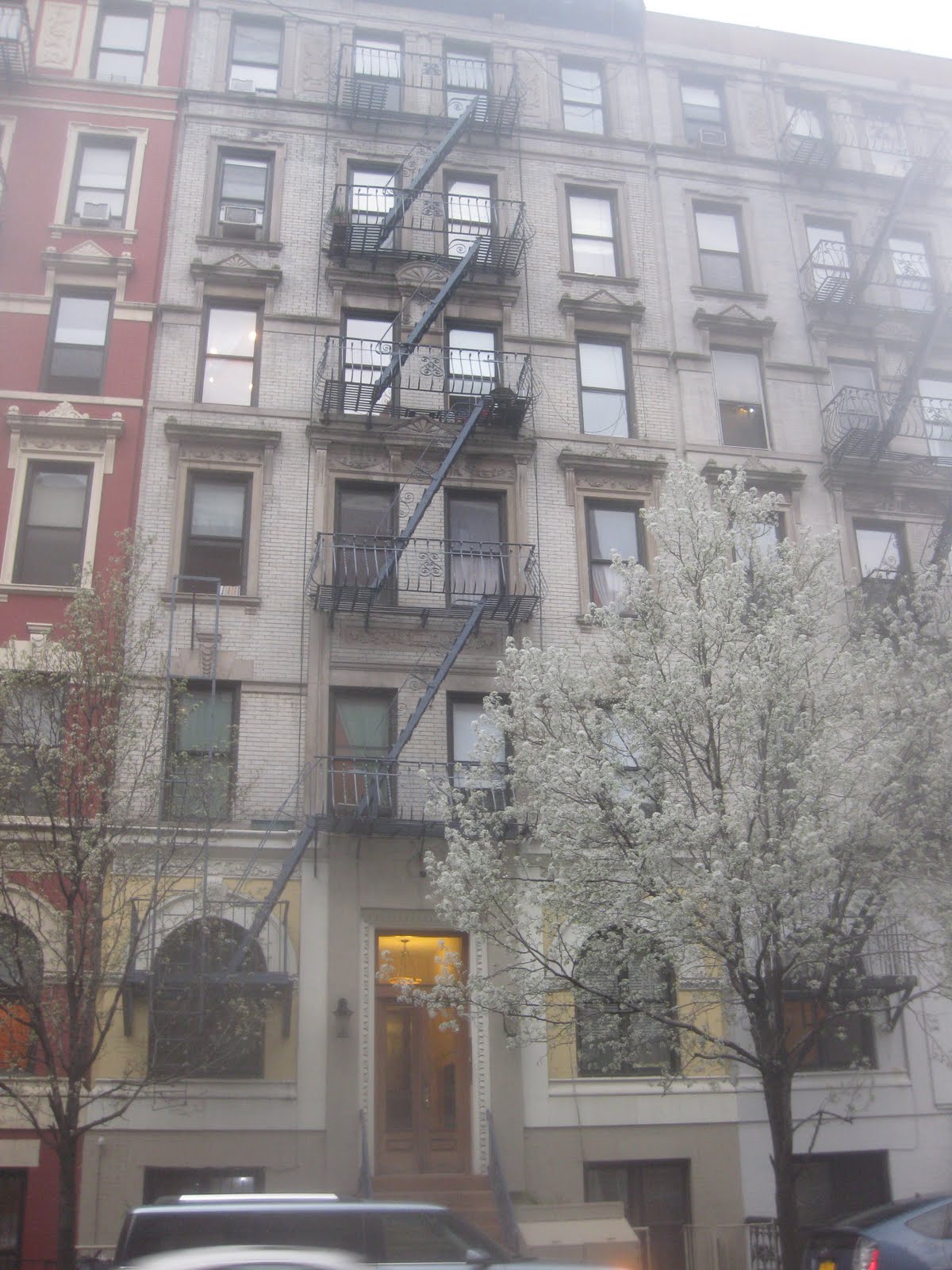
The area in the 1930s was known for it's radio-parts stores.
The twin towers.
This Sunday the twelfth will be one year since I've posted my first blog about the life and times of yours truly living in New York City, and, oddly enough, I've never even mentioned Ground Zero, the site of the city's biggest event, so I thought I'd give it a go. Actually, I think the name "Ground Zero" is practically never used anymore, because it looks like the city's actually making some progress. When I'm down there, its strange to see part of the Freedom Tower for real instead of just in CGI. (Forgive me, nobody is calling it the "Freedom Tower" anymore, either. That was just one of those terms that seemed to stir people's emotions shortly after 9/11, but nobody wants to call the building that FOREVER. World Trade Center 1 is a better fit.) That area remained a giant construction site for years, though. Like so many other places in the city, it was an inconvenient eye sore that stayed put while bureaucracy took over. But this September 11th will be the ten year anniversary, so suddenly everyone's rushing to get at least the memorial finished.
Plans to develop a World Trade Center in New York City were first suggested in the early 1940s, but the city's economic growth was concentrated in Midtown Manhattan, around the city's most striking skyscrapers. But by the early sixties, prominent businessman David Rockefeller suggested a new center in Lower Manhattan to promote urban renewal. Previously, the area had been somewhat neglected. Small antique shops lined the streets, and it was the center of the radio repair trade, with such prominent radio-part businesses as Heins and Bolet. Its hard to believe that there was once a time not too long ago where when you bought something, you kept it for life. That mentality, in a way rather regretfully, seems pretty far removed from how the vast majority of Americans live today. But it's also a result of progress, technology building upon itself at such a rapid rate that most people wonder if they can keep up ... myself included. How about a computer or a phone that doesn't go out of date in a year? I still use my phone to call people and talk to them (what a concept) and I'm sure my computer is a few years out of date but by God it gets the job done! (And by "the job", I mean departing this gem of a blog to you my readers. You're welcome.)
Anyway, I'm rambling. The twin towers, when completed in 1973, were the tallest buildings in the world, and despite their ugliness and plainness that everyone always criticized them for (I would've too if I had even been that aware of the city's landmarks back then), they were a pretty impressive testament to the city's industry. Like everyone else, I remember where I was that morning -- in my college dorm room at New Paltz, and, like most of us, it was the most unreal thing I'd ever witnessed. To this day I sometimes find it kind of absurd that these hijackers actually pulled it off. It also feels good to finally say the U.S. got Bin Laden, but I never would've thought it would take almost ten years.
Anyhow, I took a few pictures and started to take the long walk back up to the Upper East Side. In the quest to lose a few pounds and reacquaint myself with an active lifestyle, I've been trying to take these long walks around the city more. I headed north through the narrow streets of TriBeCa and SoHo, and up toward First Avenue, past Bellevue and the U.N., even briefly running for a block or two. Boy were my dogs barking, but you know me ... eye of the tiger!
Graffiti dating back to about 1800 was found in the rooms upstairs.
South Street Seaport Museum's historian Jack Putman exploring upstairs.
Joseph Mitchel returned to the hotel in the '90s.
Louis Morino in the '50s.
A last look at the old hotel along water street.
The former Sloppy Louie's is now a dining room for the Heartland Brewery.
The Brooklyn Bridge from the South Street Seaport.
The front door of what is now a Heartland Brewery Branch.
The boarded up old hotel dates back to 1811.
A sign in the window for Pittsburgh's Iron City beer, a favorite of mine.
A ship sits in the seaport.
The Manhattan Bridge from the South Street Seaport.
I recently finished Joseph Mitchell's acclaimed essay, "Up in the Old Hotel". Written in 1952, it's an account of his many interviews with old friend Louis Morino, the proprietor of Sloppy Louie's, a seafood restaurant at 92 South Street in the heart of the Fulton Fish Market. The building, however, opened up in 1811 as a courting house (I'm not sure what that is), but was converted to an upscale hotel shortly thereafter. Sloppy Louie's, I was surprised to learn, stayed in business as late as 1998, and Sweets Restaurant next door was a city staple from 1847 to 1992. Unfortunately, in the nineties gentrification took over.
Louie always hated the name of his restaurant, but another Italian immigrant who owned the place before him, John Barbagelata, informally called his restaurant "Sloppy John's". The name was so popular with patrons that it carried over, and eventually Louie ordered a big sign with the name, saying that he couldn't beat them, so he joined them.
Mitchell had been going to Sloppy Louie's for years when he started to interview Louie about the building. By the early '50s, Louie had begun to need to expand. Stairs led to the second floor of the building, where he originally kept supplies and where the workers could change, but only an ancient pully-operated elevator led to the floors above. That being a rather unreliable mode of transportation, the floors above were simply neglected for years. Louie told Mitchell that in over twenty years of business, he had never been up there even once.
Louie at first wasn't aware of the rich history of the building his restaurant was in until he was unexpectedly visited by the matriarch of the Schermerhorn family, who arrived out front in a stretch limo to get an update on the condition of the building. The Schermerhorns were a prominent family who owned a number of popular hotels and boarding houses in the 19th century. With the ferry to Brooklyn right there, the old hotel at 92 South Street and others surrounding it became a bustling tourist destination. But over the years, with the building of the Brooklyn and Manhattan Bridges and the subway system, the area went into decline, and what used to be a fashionable middle-class clientele turned more into a seedier breed of sailors and longshoremen. The nail in the coffin for the area was Prohibition, when the tavern on the ground floor of the building was forced to close.
By the early fifties, Louie and Mitchell had convinced each other to take that old elevator upstairs once and for all, and what they found among the cakes of dust was piles of old hotel furniture which had been sitting in the dark for decades. A sign on the wall read, "THIS READING ROOM WILL BE CLOSED AT 1A.M. FULTON FERRY HOTEL". Another read, "ALL GAMBLING IN THIS READING ROOM STRICTLY PROHIBITED. BY ORDER OF THE PROPRIETORS. FULTON FERRY HOTEL." Some cabinets, bureaus and mirrors were left in place, and around the corner there was a long hall with rows of bedrooms, that contained a couple of old bedframes and coat hangers,
Louie found the whole experience to be rather depressing, and wanted to get out of there, not even bothering to go up to the fourth floor, and so they left, without even bothering to go up again. It wasn't until over forty years later, when Jack Putnam, historian of the newly-opened South Street Seaport Museum, invited Mitchell to explore the floors on the upper level once more. Rarely opened to the public due to its unstable condition, the hundred-plus-year-old furniture, plaster and wallpaper remained virtually intact.
And so I decided to head way downtown to try to find the old hotel for myself. Following the door numbers along South Street, I eventually came across what is now a Heartland Brewery, a chain in the city, with other locations in Union Square and the Empire State Building that makes it's own line of craft beers. I went in, ordered a beer, and began to ask the bartender what he knew about this place. He had never heard of Joseph Mitchell, but he told me that this used to be the North Star Pub, and before that Sweets Restaurant. To my left was a dining room annex that was boarded up when Heartland moved in, but was recently opened to the public. That was once Sloppy Louie's, he told me. Around the corner is an Ann Taylor which also occupies the second floor, and further down the street is the museum. I asked him about the old abandoned hotel, and he said that the top three floors still contain all that old furniture from the nineteenth century, but very rarely is anyone allowed up there. He had never been up there, and neither had anyone he knew.
With that I thanked him for his help and told him I'd see him next time. I've heard that those floors are going to be renovated and opened to the public someday, but so far that isn't happening. Taking one last look, I headed back uptown, leaving behind that relic of a long-gone city.
The historic Chelsea Hotel is up for sale again, and since the weather has been so fantastic lately, I decided to take a walk down there recently to take a look at it. In Chelsea you can find a number of great-looking old buildings from the late 19th century, many of which survived from when this area served as the most fashionable part of town. My mother has been reading a book about Robert Mapplethorpe's and Patty Smith's time spent there in the early '70s, when it was home to some of the most creative people staying in New York City.
The Chelsea Hotel was built on West 23rd Street between 7th and 8th Avenues in 1883 as the first co-op apartment building, and was the tallest building in New York City. It remained so for nearly twenty years until the Flatiron Building was completed as the tallest building in the world two-and-a-half blocks south in 1902. Once surrounded by Ladies' Mile and the theatre district, the co-op went bankrupt after only a few years when the city's theaters and shopping centers migrated uptown and the nation suffered a minor (comparatively speaking) recession. Abandoned for a few years, it reopened in 1905 as a hotel. It flourished for a few decades until being bankrupted again by the Great Depression, and in 1939 was purchased by Joseph Gross, David Bard, and Julius Krauss, who managed it as partners until the early '70s. With the passing of Gross and Krauss during this time, the management went to Bard's son, Stanley. In 2007, Stanley Bard was ousted by the board of directors and Dr. Marlene Krause, Julius Krause's daughter, and David Elder, grandson of Joseph Gross, replaced him with the management company BD Hotels, which has since been relinquished from ownership as well.
The hotel has been home to Mark Twain, O. Henry, William S. Burroughs, Leonard Cohen, Gore Vidal, Arthur Miller, Quentin Crisp, Tennessee Williams, Allen Ginsberg, Brendan Behan, Thomas Wolfe, Stanley, Kubric, Ethan Hawke, Dennis Hopper, Uma Thurman, Michael Imperioli, Jane Fonda, The Grateful Dead, Iggy Pop, Tom Waits, Janis Joplin, Rufus Wainwright and countless others. Charles R. Jackson, author of The Lost Weekend, about an alcoholic who frequents P.J. Clarke's on 55th and 3rd, committed suicide in his room in 1968. Dylan Thomas collapsed in his room here after drinking too much at the Whitehorse Tavern on Hudson and West 11th Streets. Jack Kerouac wrote On The Road while staying here. Sex Pistols bassist Sid Vicious allegedly murdered girlfriend Nancy Spungen here in 1978, but many believe someone else killed her, such as one of the two drug dealers who visited their room that night.
Artists such as Julian Schnabel, Jasper Johns, and Andy Warhol lived here, and as I walked in the lobby I saw that it was adorned with some pretty crazy-looking art. I particularly remember the giant horse-head painting that was to my left. This hotel became a safe-haven for artist and the like who didn't seem to fit into the mainstream. Fans of the hotel have always praised it for it's inclusiveness, and some feel it is the last remnant of a once bohemian city. Many people who lived and hung out here long to keep its artistic tradition alive, and hopefully whoever buys the hotel next will respect this.
I walked around the neighborhood a little more on that Sunday evening, taking in what the neighborhood has become, and what it used to be that all these New York City bloggers wistfully reminisce about. "Billy's Topless" on 24th and 6th was shut down by Giullianni ten years ago this month, and has been a a cafe for a long time now. The "Limelight Disco" on 20th and 6th is now the "Limelight Marketplace" and just about a month ago has started selling Grimaldi's pizza. Of course not that these changes are all bad (anyone who longs for the old city has to admit that Billy's Topless and the Limelight weren't the most wholesome places in the world), but, as usual, it's all about making a buck, and the common New Yorker gets left behind. The Jefferson Market Library on 10th and 6th is locked up for some reason (hopefully not for good). I'm assuming it's just for renovations. The sign on the door directs people to go the the Muhlenberg branch near the Chelsea Hotel, named for William Augustus Muhlenberg, the first pastor of the Limelight when it opened up as the Church of the Holy Communion in 1846. When he donated his collection of books it became the core of that library. Anyway, my dogs were barking by the end of the night, so it was time to head on home until my next rambling.
202 East 13th Street, without the "ROOMS" pillars.
The brothel is at 226 East 13th Street.
Travis and Iris go to Disco Donut diner on 14th and 3rd, now boarded up.
This furniture store seen in the background still remains on 13th and 3rd.
Travis waits for the gun dealer on the NW corner of 19th & 5th.
This hardware store sign on 19th between 5th & 6th can be seen in the movie.
The NE corner of 19th and 5th used to have a diner, now a Sephora.
28th & Park, site of the Belmore Cafeteria.
Muldoon's on 45th & 3rd appears in the beginning as McAnn's.
The new New York Times Building, site of the Terminal and Exchange bars.
The porn theatre Travis visits on 45th & 8th in the beginning seems to be demolished.
A porn theatre seen in the back as Travis walks down 8th Ave. is now the Tour Bus staion.
The campaign headquarters on 63rd and Broadway.
A few weeks ago I saw Martin Scorcese's 1976 cult-classic Taxi Driver on AMC, and decided to take a walk around the big city to some of Travis Bickle's haunts that can be seen in the movie, much of which has changed a lot. It's been a pretty lousy past few days weather wise, but I figure the gloom of the weather coincides well with the ambiance of this movie. Although we don't always like to admit it, it can be pretty easy to become like Travis Bickle, at least a little bit. I found a special about the making of Taxi Driver on YouTube the other day, in which they said that the movie is about more than just loneliness, but a certain kind of loneliness that feeds on itself, that prevents someone from ever getting where he's going. In the special, I think it was Peter Boyle who said something along the lines of how the city is where you go to get crazy, but it's not a normal place to live. (I'm paraphrasing a lot here. I'll try to find what he said later.) And although the city is crowded with people everywhere you look, it fosters loneliness and isolation because we're all trying to keep to ourselves. When I first moved back to the city, it was a feeling that was very real to me, but which I didn't expect to feel at all.
A lot of critics say that the subject matter of this film wouldn't fly today. The concept of the anti-hero, who walks the fine line between hero and villain, would be too controversial. Travis, through happenstance, kills a pimp instead of a presidential candidate, is lauded as a hero for saving an underage girl from a life of prostitution, and continues living and working as a cab driver around the city, but with an extra bullet or a wrong turn, he would've ended up killing the wrong person or even himself. Travis, in his intense isolation, is in desperate need to give his life some kind of purpose, some kind of righteous mission to validate his own existence.
On that note, I headed over to 63rd and Broadway, where the campaign headquarters was located. Then I walked down to 48th and 8th, where I used to student teach a few years back. In the nineties 8th Avenue from 40th-50th Streets switched to being a tourist industry hub from a porn industry one, and the station for those big red buses we see all over the city can be seen in most Taxi Driver movie posters as a giant adult theatre in the background as Travis Bickle walks along 8th Avenue. In this shot in the beginning of the movie, he heads for a smaller adult theatre and once inside tries to hit on the concessions girl. According to one of my favorite websites, New York Songlines, this later became a dangerous pimp hangout called "Little Annie's Full Moon Saloon" and was now a dive called "Collins Bar", which I looked up and has subsequently closed down as well. In fact, I think the building might be gone. There's currently a giant lot next to the Subway shop I used to go to all the time when I was immersed in the joys of teaching eight-year-olds.
Further down on 41st Street were the Terminal and Exchange Bars right next to each other -- two more dangerous pimp hangouts seen early in the movie that were demolished in 2007 to build the 52-story glass structure that holds a family-friendly cafeteria and the New York Times newest home since moving from 43rd Street, where it had been since 1913.
Across town there's Muldoon's on 3rd Avenue between 43rd and 44th Streets, which used to be McAnn's, yet another bar Travis hung out at, seen in the beginning of the movie, and, on 28th and Park, a 1983 high-rise condo marks the spot where the Belmore Cafeteria was. This diner, which I guess was on the decline even back then considering when the new building went up, was a well-known taxi-driver hangout. Wizard takes up the lost cause of trying to help Travis tame some of his demons as the reflection of the Belmore's old neon sign shines on the building across the street. My father was a taxi driver for a few nights in the mid-seventies, and recalls it as being an awful job, but told me the Belmore was mentioned as a popular hangout by the other drivers in the garage.
I further walked down to 5th Avenue and 19th Street, my old stomping grounds, and the corner where Travis gets into a cab with gun-dealer/traveling salesman "Easy Andy". Tomorrow, oddly enough, it will be three years since Alger laid me off and I'm beginning to feel like God's Lonely Man a little bit myself. These buildings are all pretty old so they look basically the same now as they did in the movie, except the diner across the street (the north-east corner) is long gone and has been a Sephora for the past few years. However, about last September or so I found a great website that dissected the movie scene by scene, pointing out things in the background, and it seems the only storefront that remains exactly the same is a simple vertical hardware store sign on 19th Street between 5th and 6th Avenues, seen when the cab drives off. When I was the generic assistant at Fred Alger Management around the corner, I was sent to this place often to go get keys made or buy nails.
As I walked along, I came to a boarded up one-floor structure on the southwest corner of 14th and 3rd. Slated for destruction, probably to make way for more NYU developments, in the '70s this was Disco Donut, a diner where Travis takes Iris out to lunch, and around the corner on 13th between 2nd and 3rd was where she lived and worked. I've added a video here of Travis and Iris talking for the first time and Travis meeting Iris' pimp for the first time, but YouTube might remove it soon ... they've done so with other scenes in the movie. Iris' silent friend was an actual child prostitute and drug addict who worked the city streets. She was about fifteen, and coached Jodie Foster on wardrobe, mannerisms, and the like. Harvey Keitel brought a great deal more depth to the role of the pimp than was originally intentioned. Originally offered Albert Brooks' role as the campaign manager, he asked for this one. Plus, the original plan to make the pimp black was scratched when it was thought that it would cause too much controversy, considering that the movie already contained a great deal of racial tension.
In the background, you'll see on the southwest corner of 13th and 3rd is a unpainted furniture store that is still there today, and the door at 202 East 13th Street used to be flanked by big, gaudy pillars that advertised "Furnished ROOMS". Probably the most famous picture of Jodie Foster as Iris shows her standing in this doorway, but Travis meets and talks prices with her pimp at 204, and the actual brothel with the bloody finale was at 226. All of these then-run-down buildings probably rent for thousands-a-month now. When I was standing on the block I saw a sign at one of them advertising co-op apartments. Boy have things changed.
That's what New York City blogs always seem to come down to these days: boy have things changed. Taxi Driver became a cult classic by telling the story of a loner who's disgusted by the cesspool that is Manhattan, but as many New Yorkers would say nowadays: At least he could afford to live there. At least he's not being pushed out. And a lot even say: At least the city had character back then. I don't know about that, although that time does kind of fascinate me. If this city is going to be salvaged for the middle class at all, though, its going to have to find a way to create affordable living and a low crime rate. Why having both seems so impossible is beyond me.
The FDNY pipe and drum band at the end of the parade.
Marching up 5th Avenue.
Another shot up 5th Avenue, follow the green line!
Myself with Division 1 of the AOH, holding the banner.
Myself with one of Division 1's VPs.
The banner, Thomas Rogers Memorial.
Another shot of the banner for the Ancient Order of Hibernians, Division 1.
This past Thursday, New York City held it's 250th annual St. Patrick's Day parade. It's one of the city's oldest traditions, dating back to 1762, when ex-patriot British soldiers from Ireland marched in formation up lower Broadway, playing traditional songs, wearing green and speaking Irish, which was all banned in their home country. After the Revolution, the parade transformed from being a military review of British soldiers to being a gathering of the many religious, cultural, and social organizations of the city's Irish. By the the time Old St. Patrick's Cathedral on Mott and Prince Streets was finished in 1815, these various groups would start from their church or headquarters, around such places as St. Peter's on Barclay and Vessey Streets, St. James' between the underpass of the Brooklyn and Manhattan Bridges, and St. Joseph's on West 8th Street and 6th Avenue, and all march toward the cathedral where they would be met by the Bishop of New York. A mass or prayer service would be held where the bishop and other dignitaries and politicians would speak, and then everyone would disperse to start celebrating.
As the heart of the city migrated further north, so did the Archdiocese with a new cathedral on 50th Street and 5th Avenue, and so did the parade. By 1851, the parade began to to unite under a single grand marshall and be led by the newly formed 69th Regiment of the Irish Brigade, which it still is to this day. Also, since 1851, the Ancient Order of Hibernians, who formed at St. James Church in 1836, have sponsored the parade. I started marching in 2007 after I had joined to AOH a almost a year earlier in April 2006. Originally founded to defend and protect Irish Catholics in America by guarding churches that would otherwise be vandalized and burnt to the ground, and standing up for the rights of neglected Irish workers, they seemed to have evolved into an organization of older guys who talk about organizing charity drives, cultural events, the Christmas party, and what time and where to meet for the parade on March 17th. All in all, pretty light stuff ... and, no, ILGO and all those gay people who are supposedly "banned" have never once been mentioned. But the parade, the largest in the world, upholds strict traditions by not having political activist groups, pro-Catholic or not, march, as well as remaining strictly a marchers' parade by not allowing floats or cars. As a member of Division 1, we meet where it all began, far downtown in Manhattan, at the Mercantile Grill on Pearl Street, not too far from Fraunces Tavern at the end of the block, where George Washington said farewell to his officers and went back home to Virginia at the end of the Revolution. However, being a Upper-East-Sider, this is my excuse for never making it to the meetings.
The parade is always backed up, and we stood on 46th Street and Vanderbilt Avenue for about two hours, and then finally was the long haul up to 79th Street. Unfortunately, the parade, and all parades in the city, were cut short by Bloomberg starting in April of last year to supposedly cut costs on sanitation. Last year's St. Patrick's Day parade was the last to march up to 86th Street and past the Irish Historical Society on 83rd Street, as the new rule went into effect on April 1st of last year. That's Bloomberg for you: if he decides he wants to do something, he just goes right ahead and does it, often despite what most New Yorkers want. It's a hefty walk just the same, though, and as it nears the end you seem to get a less formal crowd of little kids holding out their hands to slap five and older "big kids" drunkenly yelling things. All in all, there's a lot of history and tradition to all of this, and I'm happy to be able to take part in the largest parade in the world. Celebrating afterward is always good, too.
Pinnacle Bagels was Valensi's parents' restaurant in the '80s.
The Gap on 42nd and 3rd was the nation's last automat until 1991.
The Strokes are currently on tour again. Little known fact, but I was once, very briefly, good friends with guitarist Nick Velensi in the second grade. For some reason, there was a time when we were around seven when he really liked me. As true then as it is now, he always seemed a little bit cooler than everyone else, especially kids like me and my brother. To prove what was already obvious to us all, Nick Valensi threw the party to end all parties at his ultra-hip parents' restaurant on 3rd Avenue at about 45rd Street in honor of his turning eight years old, and invited Mrs. Turner's entire second-grade class at P.S. 183 on East 66th Street between 1st and York Avenues.
I wish I remembered more from that night, or at least that my parents did, but all I remember was that it was a very sophisticated, adult party, set in a very loud, dark bar/lounge/restaurant, that we all seemed to be about ten to fifteen years too young for. My father remembers a large staircase leading up to the second level, lined on both sides with girls all about eight to ten years old, dressed and made up to look like they were in their twenties. Nick came with an entourage of mature-looking girls on his arm and mixed and mingled with the rest of us.
In the meantime, my dad headed out after dropping us off. My mother was at home under the covers at the time, with just about the worst case of the flu she had ever had, plus eight month pregnant with my brother Joe. So my father decided to give her some time to herself and walked down three blocks to the automat on the southeast corner of 42nd Street and 3rd Avenue. Automats, considered the height of modern-day eating-on-the-go, and an iconic symbol of New York City around fifty years earlier, were already far past their golden age, and this one on the corner of 42nd and 3rd would be the last in the country, closing two years later. Some folks tried to give the automat concept another whirl in 2006 in the East Village, with BAMN! on St. Mark's Place between 2nd and 3rd Avenues, but it closed three years later due to lack of interest. This type of dining that was once so quintessentially New York had rapidly declined in popularity due to fast food joints and people wanting fast food that was (supposedly) fresher. It was all too evident on that Saturday night in January 1989 that the automat had long past its height of popularity as my father sat there with five bums, trying to give my sick mother at home some peace and quiet.
But you know how little kids get sometimes about late-night parties in nightclubs, and only about a minute after our dad walked out the door, my brother Patrick freaked out and wanted to go home immediately. Nick's mother's only choice was to call our apartment. With that, our mom had to somehow drag herself out of bed, drag herself down the stairs, and hail a cab to come pick up Pat, all the while unbeknownst to us all that Dad was just a few blocks away. Such was life before cell phones.
Looking back on it now, my mom says it seems like such a dated story. There were no cell phones so my parents couldn't communicate (something that is so easily taken for granted now) and my dad was hanging out at the automat, one of the most dated of New York City institutions. It finally closed in April, 1991, and there's a Gap store there now.
I walked up Third Avenue the other day to try to find the building where that restaurant used to be, and I think it's Pinnacle Deli and Hot Bagels, between 45th and 46th Streets. Nick, I know you're a big-time rock star now, but remember me -- Jamie Meehan -- your old pal from Mrs. Turner's second grade class?
Avalon Bowery Place on the Bowery between Houston and 1st Streets.
Lately I've been reading "Up In The Old Hotel", a collection of stories by The New Yorker columnist Joseph Mitchell. All written around 1938-43, they're mainly human-interest stories of elderly, slightly off-beat New Yorkers whose heyday was about thirty years earlier. The latest one I finished was on a Commodore Dutch, an eccentric old man who wore a well-preserved but ill-fitting suit and survived solely off of the generosity of others. He was president of an "association", a hold-over from the rackets of the Tammany Hall days, that had "members" and "officers", who paid him dues regularly, and each year he would hold a ball. Dutch created the association because he owed a debt to Boss Sullivan after a long night of drinking along the Bowery, but long after the Tammany Hall machine had lost most of it's power, and the parties and fundraisers it held became a thing of the past, Commodore Dutch continued to hold his ball each year well into old age, relying solely on people around the city who seemed to get a kick out of his eccentric personality.
According to Mitchell, Dutch got the title "commodore" from John McGurk, a bartender who proudly owned "the roughest joint in town", McGurk's Suicide Hall. Every time I've read about this place, it has always been mentioned that at least five "back room girls" killed themselves by drinking carbolic acid there in 1901, thus giving the place its infamous name. Mitchell mentions this, too, in this 1941 story, and how Dutch got one of his best jobs around that time from McGurk, when he would round up sailors from the South Street Seaport and bring them up to that rough saloon at 295 Bowery at East 1st Street. Unfortunately, it was demolished in 2005. Despite a small fight to give the building landmark status, the Landmark Commission didn't feel that it had enough architectural significance.
The other day I got a well-needed haircut from my cousin who's salon is a block west of the Bowery on Elizabeth Street. So I walked around for a while while down there, noting the big new glass building that was built in place of McGurk's, and, half a block up, at Bowery and Bleecker, John Varvados, a ridiculously expensive clothing store, which used to be CBGBs. You've got to hand it to them, though -- they let people walk around the place without having to buy anything. So I walked around the old rock club, noting the old band posters and the drum set they had set up where the stage used to be, now covered in very expensive shoes.
I then walked around the corner to Marz Bar on East 1st Street and Second Avenue. This place has been long known as a beloved dive bar of the punk rock scene. Wow, what a dump this place was -- and I consider myself someone who likes dive bars. I looked around briefly and said, "Forget this, I've got to get out of here," or something like that. I read recently, though, that that bar and another one called Max Fish were going to be closed down in a matter of weeks, so I felt I had to pay them a visit.
A guy I met a few months ago who worked full-time at Lord and Taylor told me that the ill-fitting suit he was wearing was the only one he owned and that he was a punk-rocker at heart. He told me about the glory days of how those two awful little holes-in-the-wall Marz Bar and CBGBs were around the corner from each other, and how the city just isn't the same, etc., etc. If Lord and Taylor had considered me worthy to partake in their minimum wage payroll, it may have been the beginning of a beautiful friendship with this punk rocker, but as it turned out I don't even remember his name.
Mitchell's story of Comodore Dutch also mentions Big Tim Sullivan's unofficial headquarters, the Occidental Hotel on the corner of Bowery and Broome Street, which around 1911 was one of the fanciest hotels in town, but, as Dutch had bemoaned, by 1941 had become a run-down flophouse (like countless other on the Bowery) where one could stay for three dollars a week. Still standing today as a two-star hotel called "SoHotel", it is the city's longest continuously-operating hotel, dating back to at least 1805, with a chandelier store on ground floor.
Dutch recalled how the beloved, seemingly invincible boss of the Bowery slowly began to lose his mind as he got older, and was put in a home up in the Bronx, where he would occasionally escape, and cops would often find him a few hours later sitting in the lobby of the Occidental. Until one day he escaped for good. A body was found on railroad tracks up in Westchester, and remained unidentified for fourteen days. When it was about to be put in a potter's field, a cop identified him at the last minute. A funeral mass was held for him at Old St. Patrick's Cathedral on Mott and Prince Streets, where Dutch marched in the procession and as he put it, cried the whole time. Sullivan's funeral, according to Dutch, spelled the end of the racket scene on the Bowery, as the gambling dens and bars migrated uptown and then started to dwindle away. Dutch, though, kept the dream alive buy continuing to hold his ball each year. And in 1941, he was able to rent out the back room of a bar on 3rd Avenue near 50th Street. Some people would stick around out of fascination, but would leave out of frustration when Dutch's crazy friends got out of hand. Among them were Ed and Pegeen Fitzgerald, long time radio talk show hosts who my grandfather listened to for years.
Reading Joseph Mitchell's stories, I'm always amazed at how relatable they are considering they were all written about seventy years ago. As I walked around downtown, I was able to point out all sorts of places that Dutch mentioned. A hundred years later, although a lot has changed, other places haven't changed at all. It just goes to show that despite progress and technology and the like, people, and the streets they walked, rarely change at all.