Monday, August 29, 2011

The Old Neighborhood

My building on 65th and 1st, built in 1898.

St. John Nepumocene Church in 1927, two years after it was built.

St. Catherine's Park in 1902, before it was finished.

The schoolyard of P.S. 183 on East 67th Street between 1st and York.

Side doors of the school are labeled "BOYS" and "GIRLS".

The front door of P.S. 183 on 66th between 1st and York.

St. Catherine of Sienna Church on 68th between 1st and York.

The Dominican Friars were celebrating St. Domonic's Day.

The cornerstone shows St. Catherine's was  built in 1930.

Another shot of the schoolyard of P.S. 183.

The new high-rise that went up next to St. John's just a couple of years ago.

St. John Nepumucene Church on 66th and 1st today.

The sign for Peppermint Park still remains at the door of what is now a Dunkin' Donuts.

St. Catherine's Park on 67th and 1st.

You know how when you're in high school and you go back to your elementary school and it looks like the hallway has shrunk? Everything is much smaller than you remember. The walls are closer together and the water fountains are at your knees. Well, when I moved back into the apartment that I had moved out of when I was a kid a few years back, that's the way I felt about the whole neighborhood. Places that were actually only a block away, I remembered as being about five blocks away.

The church where I was baptized and had my first communion, St. John Nepumucene, or St. John Nepumuk, is on the corner of 1st Avenue and East 66th Street. Founded by Slovakian immigrants, it is served by two Hungarian priests, one old and one young, has a Hungarian flag at the altar and has mass in Slovak every Sunday. When the first big influx of immigrants from Slovakia arrived in the city, there was a big call to form a parish of their own where they could speak their own language. They started meeting at St. Brigid's on 8th Street and Avenue B, and organized their first parish on East 4th Street. The current church was finished in 1925, and it really is a beauty. It's often open during the day and I like to go in an admire the intricately designed stained glass, statues and grotto in the front. Further down the street is P.S. 183, my old school, and around the block is the schoolyard where I spent many an hour. The layout, and the farmers market they have on Saturdays, has remained pretty much unchanged since the eighties.

On 68th between 1st and York is another Catholic church, St. Catherine of Siena, built in 1930. This parish was formed in 1897 mainly for the Irish community, and the current church, run by the Dominican friars, is actually quite massive, with a number of shrines lining the walls. Up the street on 1st Avenue is the park also named for the saint where I spent a great deal of my early childhood. Back then we all called it the "local park", and for years I thought this was it's official name, but as it turns out, it too was named for St. Catherine. When the land was purchased in 1902, the park's design was based on Santa Maria sopra Minerva in Rome, built in 1280, where St. Catherine is buried. The flagpole in the center of the park represents the altar, the play areas on either side are the pews, and the paving pattern of the park resembles that of the floor of the church in Rome.

I found this out from reading a history of St. Catherine's Park I found online, but I think they only describe the original plan. The park has been remodeled at least twice since I moved upstate to Nyack. The plan of my childhood was so full of jagged corners, steep falls and high walls that my father used to joke that whoever designed this park obviously didn't have any kids.

When the park was redone shortly before we moved in 1989, it was widened in the center so that police cars could drive through, in an effort to crack down on the drug dealers that were starting to take the place over. But who wants to take their children to a park that is being patrolled by cops non-stop? Now, with crime drastically decreased in the city, the design is at its most practical, with a playground and swings in the center inhabited by little kids and there parents, flanked by an area with benches inhabited by old ladies and me, and the ball court that hasn't changed much at all.

New York City bloggers are always bemoaning the rapid disappearance of small business in place of large chains, and the old neighborhood has seen it's share of that. A bank in my building used to be a suede store, a dry cleaners was a souvenir shop, and the neighborhood ice cream shop on 66th Street, Peppermint Park, is now a Dunkin' Donuts, but at least the old sign still remains. Not to mention, a giant high rise went up right next to St. John's about two years ago. Despite all this, Goldberger's Pharmacy, also on the ground floor of my building, has remained in place since 1898. Even with a Duane Reade on practically every block, it refuses to budge.

Goldberger's and Wise Pharmacy on 79th and York must have very low rent which allows them to defy the odds and stay in business. They probably have been around since my building and a similar one on 79th and York went up in the 1890s. Built with the vision of providing comfortable living for the working class, the apartments included such luxuries as their own bathrooms, a far cry from the tenements of downtown. Now these buildings are City Landmarks.

All in all, I'm glad to be back in the old neighborhood, and if I can ever catch a break in the midst of this recession, I hope to be here for many years to come.

Tuesday, August 2, 2011

The Lone Star Cafe


Construction of the new branch of Shrafft's began in 1936 after an old brownstone was demolished.
The Lone Star Cafe in 1978.
Another shot of the new building going up in place of the Lone Star.

The new high-rise going up in July 2011.

An interior shot of the new Shrafft's on at 61 5th Avenue, corner of East 13th Street, in 1938.

A shot of the front entrance in 1938.

The Korean Deli that was the building's last occupant in 2005.

The Lone Star Cafe in the '80s.

The 40-foot-long iguana keeping guard at the Lone Star about 1987.

I was walking around in Greenwich Village the other day and came across the new building going up in place of the former Korean deli on 5th Avenue and 13th Street. In 1936 a brownstone was demolished to make way for a new two-story Schrafft's, probably the most popular chain of diners in the city during the '30s, '40s and '50s. A number of photos from the Metropolitan College of New York show what a beautiful place it was when it was first built. A revolving door led to a cocktail bar to the right and a spiral staircase to the second floor on the left.

Critic Lewis Mumford didn't like the place, though. He hated its "screwy" curved front, calling it "the new cliche and it will soon belong in the done to death department." He went on to say that the building is "a pretty sorry mismatch" with "ill-assorted windows" and a "crazy little balcony".

These pictures were taken in 1938, when the place was still new and fashionable. By 1969, it had become the hang out of staff members from Women's Wear Daily, the New School, and loftmen from 14th Street. According to a 1969 New York Magazine article called "The Little Old Lady Restaurants", Schrafft's would fill up with L.O.L.s (which back then didn't mean "Laugh Out Loud"). In an effort to revamp their not-very-hip image, they hired Andy Warhol to do a commercial about the chain. But it was what it was, and ultimately closed a few years later.

In 1976, it became The Lone Star Cafe, the city's most popular country music concert venue. It hosted a number of musical acts, and particularly featured acts from Texas. Roy Orbison, Willie Nelson, Kinky Friedman and Billy Joe Shaver all did regular shows there. The Blues Brothers and James Brown also did shows there, with Brown recording a live album there in 1985. The place was also visited by Texas TV personalities such as Larry King, Dan Rather and Linda Ellerbee. My parents went to see rockabilly musician Robert Gordon there when they were dating.

Over the front entrance was draped the line "Too Much Ain't Enough" from Waylon Jennings' song "Old Five And Dimers Like Me", and the building was famous and infamous for the 40-foot long iguana sculpture on it's roof by Bob "Daddy-O" Wade. The place didn't really fit in with its upscale neighborhood, and local residents fought a hard battle get rid of the sculpture, considering it to be an eyesore. Detractors succeeded for a couple of years and it was removed, but in 1983 it was restored and unveiled in a ceremony presided over by Mayor Ed Koch and then-Texas Governor Mark White. My father said that he wanted to take it, but that it probably wouldn't fit in our apartment.

When the Lone Star closed in 1989, the iguana went into storage on the Hudson River docks across from North Moore Street, but ultimately "disappeared". I assume it was stolen. I don't know how they pulled that one off.

Serving as a gallery for street art for a number of years and then a deli, in 2009 it joined the ranks of historic buildings in the city that have been torn down to be replaced by expensive glass boxes. A ten-story luxury apartment building is currently being built in its place. I had been on that corner plenty of times when I worked near there and never even noticed that small building with a lot of history. I try to notice as much of them as I can these days, because they're disappearing one by one.

Sunday, July 10, 2011

The Jefferson Market Library

The Jefferson Market Library today.
The Jefferson Market Courthouse and the Women's House of Detention in the '40s.
The 6th Avenue elevated line in front of the courthouse in the '30s.
Walking along lower Sixth Avenue, it's hard to miss the striking Jefferson Market Library and Garden, at the intersection of West 10th Street and 6th Avenue, a masterpiece in architecture built from 1873-7 that has just recently reopened after some renovations inside, but is still covered in scaffolding.  Walking down there to take a few pictures, I saw it was open for business again and took a look around inside.  The building really is a work of art, inside and out, and as I walked up the spiral staircase to the upper floors I saw inscribed on the circular wall quotes about justice and the law written in intricate gothic lettering.  On the upper and ground floors are ornately carved wooden entrances.  What's now the children's book room, with picture books, a group reading area and computers for teens only, were once the police courts where sensational trials of the likes of Henry K. Thaw and Mae West were held in the early twentieth century; Thaw for the murder of his wife's former lover, architect Stanford White, West for obscenity.  In the basement, there are a couple of arched castle-like entranceways to the former civil court, where the adult computers  and periodicals are.  Sherlock Holmes did his research down there in 1971's "They Might Be Giants".

Several merchants' sheds were set up on the land in 1832, along with the Jefferson Market Assembly Rooms that held trials, named for the late President, and, the following year, a large, octagon-shaped wooden fire tower in the center of the triangular plot formed by the intersection of West 10th Street, 6th and Greenwich Avenues.  Remaining for only a few decades, in 1873 new red-brick, richly decorated victorian structures began to be built in it's place, completed in ten years.  Of the nicely matching picturesque group that consisted of a courthouse, jail and merchants' sheds, only the courthouse remains.  The new, imposing tower and surrounding buildings were based on Neuschwanstein Castle in Bavaria, built for King Ludwig II from 1869 to 1886.  (Only a few blocks away, oddly enough, on the southeast corner of 17th and 7th, directly across from a bank I used to always go to when I worked at Alger, was the last home of Lola Montez, who's catch-phrase inspired the song "Whatever Lola Wants, Lola Gets".  She was Ludwig II's grandfather's mistress and was once made a countess, but died on that corner in poverty in 1861.)  The old jail was torn down by the end of the 1920s, and with Art Deco masterpieces such as the Chrysler and Empire State Buildings, a new Art Deco-style female prison, the Women's House of Detention, went up in 1932.  Supposedly, it was the only Art Deco prison ever built, and with it's walls and windows close to street level, the female prisoners could easily heckle passers-by.  Ruth E. Collins, the prison's first warden, called the completion of the structure "a new era in penology", and believed firmly in rehabilitation as well as punishment, and treating the women with dignity and as individuals.  She commissioned a number of works of art, most famously Lucienne Blotch's mural "Cycle of a Woman's Life from Childhood to Womanhood".  David Duchovny's directorial and writing debut, House of D, about his childhood growing up in Greenwich Village in the 1970s, is named for the prison and features it prominently.

Despite Collins' philosophy, the prison became notorious in it's final years over allegations of racial discrimination, abuse and mistreatment.  Black activist Angela Davis was outspoken about the cruel treatment she witnessed, and anti-porn feminist Angela Dworkin testified that she was assaulted by two doctors there.

The courthouse had it's last trial in 1945 and sat vacant until the late '60s, when it was slated for demolition, while contractors such as Robert Moses planned to build apartments there.  However, preservationist and Greenwich Village resident Margot Gayle enlisted the help of writer E.E. Cummings and historian Lewis Mumford and successfully persuaded the city to preserve the building and reuse it as a branch of the New York Public Library.

Instead of the courthouse, the prison, along with the famous mural was destroyed in 1974, mainly due to the bad reputation it had gained in its final years.  In its place a peaceful, well-cared-for park and garden was planted by community residents.  With benches, lush grass and healthy trees, it is one of the many intimate escapes that speckle the concrete city.  In 1996, after 135 years, the old bell in the clock tower rang out once again, putting, as the New York Times stated, "the 'Village' back in 'Greenwich Village'."  It rings every hour, on the hour, from 9AM to 9PM.

All in all, it's a relief for guys like me who appreciate the lost art form of a bygone era.  What a shame it would have been if this building had actually been demolished.  I walked around the Village a little more, and then headed home.  With Open House New York in November, I'll definitely get an early start to sign-ups and try to catch a more in-depth tour of this place.
Lucienne Blotch's "Cycle of a Woman's Life from Childhood to Adulthood".

Wednesday, June 29, 2011

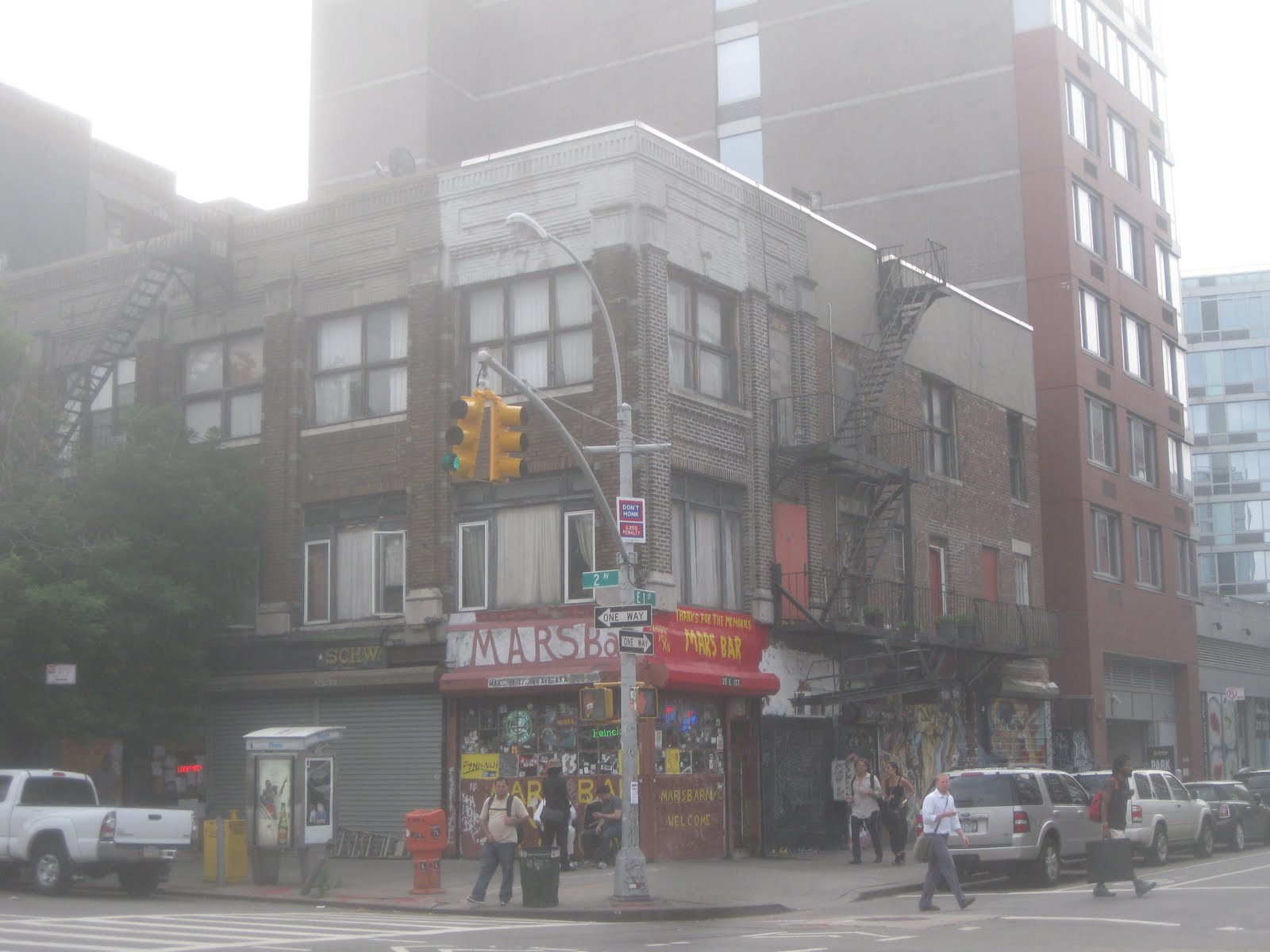
East 1st Street between 2nd Avenue and the Bowery

The Mars Bar building in the 1910s as the Woolworth Theatre.
The new glass box that stands at the Bowery and E. 1st St. today.

A New York Times article from the 1870s.
Mars Bar in June 2011.
Another shot of Mars Bar in its final days.
Extra Place in June 2011, undergoing some renovations
The Mars Bar building sat empty toward the end of Prohibition.
Mars Bar in the '40s as a coffee, tea, and spices shop.
295 Bowery, formerly McGurk's, in it's final days.
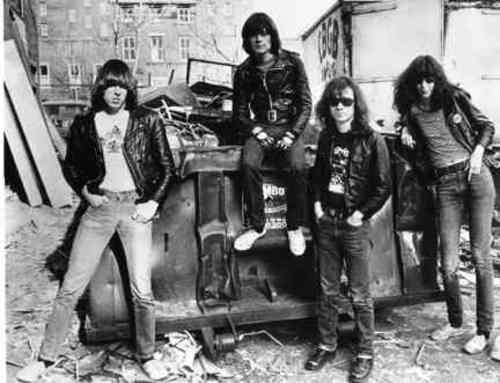
The Ramones pose on Extra Place behind CBGB in the early '70s.
Another description of Extra Place from 1952.
A description of Extra Place from 1952.
Extra Place in 1934.
An 1890s map of E. 1st St. includes "Extra Street".
Extra Place in 1978.
Around the Old-New-York-memory-lane-blogosphere these days, there's been a lot of talk about Extra Place and Mars Bar, old-rocker staples that are drastically changing or being torn down all together, years after beloved CBGB's is long gone. In 2005, historic McGurk's Suicide Hall on the Bowery and East 1st Street was demolished amid protest and replaced with a glass box, and now the same is going to happen with to the buildings on East 1st Street and 2nd Avenue. Anyone who wants to have one last beer at the diviest bar in the city, I read that this is the last week to do it.
Looking down East 1st Street from the Bowery in 2002.

Looking down East 1st Street from 2nd Avenue in 2002.
A close up of 291-295 Bowery, demolished in 2005.
No. 295 Bowery went up shortly after the Civil War ended, where it served as a political and social club for the mostly German community that inhabited the Lower East Side at the time. But throughout the latter half of the 19th Century, the Bowery became increasingly seedier. While the more upscale theatre district could be found on West 23rd Street around the Chelsea Hotel, a less desirable row of opera houses and dance halls lined the Bowery, catering to the poorer lower class. Drinking and prostitution were rampant, and it was common to find sailors and longshoremen frequenting the saloons along this thoroughfare. Back-room girls would hang around these places looking for business. John McGurk, an Irish immigrant who owned a number of saloons in the area, all shut down by police by the early 1890s, took over the bar and hotel at 295 Bowery and immediately started having run-ins with the law. He is said to have had the first bouncer in the city, who was regularly taken-in by police for assault. McGurk's quickly gained a reputation as the seediest, most dangerous hang-out in town, which is saying something for the Bowery. The prostitutes who ended up frequenting this place were very much down on their luck. In 1899, there were at least six suicides and seven attempts by back-room girls here. Some jumped out the windows up above while others drank carbolic acid. One story is of two harlots, Blonde Madge Davenport and Big Mame, who had made a pact to end it. They bought carbolic acid from the local drug store, and while Madge drank her share and suffered an agonizing death, Mame accidentally spilled most of it on her face, horribly disfiguring it. Because of this, she was banned from the bar and thrown out on the street, no longer able to do her job. To bank on his bar's morbid reputation, he renamed it "McGurk's Suicide Hall" in 1901. Unable to fight the constant police crackdowns and owing money to several people, he abandoned the place and fled to California a decade later with his wife and daughter. A final blow came shortly before his death when his daughter was denied admission to a convent school out in California when the nuns learned of the girl's father's history in New York.

In Joseph Mitchell's 1941 essay "A Sporting Man", he interviewed Commodore Dutch, a neighborhood eccentric who decades earlier had gotten his start working for McGurk, bringing sailors and longshoremen there on the weekends. In Mae West's 1932 book Diamond Lil, there's a chapter entitled "Suicide Hall", describing the place. In the 1960s, writer and sculpter Kate Millet and photographer and custom furniture maker Sophie Keir worked there. Despite some protest, the building was unable to get landmark recognition due to its unremarkable architecture and unfortunate if not colorful past, and was demolished in 2005. Next month, the remainder of the buildings that originally made up the German theatre and nightlife scene will be razed as well, and sad to say, I'm sure some giant, expensive, glass hotel will go up in it's place just like one did with McGurk's.

I'm a guy who likes an unpretentious, affordable bar just as much as anyone else, but the first time I took a peak inside Mars Bar, it was almost scary. Talk about a bunch of degenerates and druggies. My cousin who works at a hair salon nearby said she dated someone who loved the place, and there would be people passed out on the floor and in the bathroom. That's why some of the locals are glad to see it go. In a recent article I read, some bartenders said that that place took all the drunks who would be rejected any place else, so all they did was cause trouble. But the buildings that opened up as the Volksgarten and the Steuben House in the 1850's have certainly seen a lot. Called the German Assembly Rooms by the late 1800s, they housed saloons, bowling alleys, and ballrooms. Thanks to the Vanishing New York blog, I've found some great pics of the building: one during Prohibition when it was boarded up and available for lease, and another from the 1940s when it was a coffee, tea, and spices shop. It can also be seen in the opening credits of NYPD Blue (for about a second), and I've added a link. Down with it will also go the locksmith shop next store, whose owner I saw the last time I was down there, but unfortunately only saw him in an online magazine article about a week later.

The glass box on the sight of McGurk's is called "Avalon Bowery Place", and their next project is to turn the easily-missed, yet very-old "Extra Place" into the next yuppified strip-mall, filled with over-priced cafes and boutiques. I had ventured down there a couple of times to see some sort of cafe ready and open for business, tables and chairs out side, and a number of twenty-somethings enjoying the closed-off space and fresh air, but other than that, not too much. The last time I was on the block, it was closed off again -- I guess more gentrification is on its way. The alleyway dates back to about 1800, when landowner Philip Minthorne divided his 110-acre farm equally among nine children. The tiny bit of land that remained was called "Extra Place". The great Vanishing New York blog provided a couple of priceless pictures of Extra Place in the '70s, and a long-lost 1952 interview of a man who worked in a garage that was on the corner at the time. He reminisced about a speakeasy that used to be there that he loved to frequent in the '20s. I also found a great shot of the ally in 1934. Extra Place, in what some would call it's heyday, was the back door of the Palace Bar of the Palace Hotel flophouse, which later became Hilly's on the Bowery, which later became CBGB & OMFUG. Country Blue Grass Blues & Other Music For Uplifting Gourmandizers reluctantly started allowing bands like Blondie and the Ramones to play, and became the birthplace of American punk and New York City cutting-edge Rock & Roll. But as we all know now, it was evicted in October 2006, and replaced by a shoe boutique that sells blank t-shirts for $800.

My plan in the next couple of days is to take a walk down to East 1st Street and walk up and down 2nd Avenue to the Bowery one last time, just to soak up the history, and if they'll let me, get one last beer from Mars (now that I know it's safe, haha). I just want to appreciate the old buildings that are left one last time ... and as for the others, I only wish I had explored down there sooner.

Monday, June 13, 2011

Central Park

A security guard company on 42nd Street near 5th Avenue.
Don't waste your money at this place on 42nd and 5th.
For the past three years or so, I've been on the lookout for a new job, trying almost anything. Sending resumes and cover letters online, going to job fairs, calling people, calling my old job, all for naught. Usually, when I get an actual response, it turns out to not quite be a real job ... just a commissions thing, or some kind of pyramid scheme where I would never really make any money, and maybe I'm supposed to pay them about a hundred dollars for "training". Craigslist is full of these listings for security guard jobs -- "Jobs available!", "Hiring Immediately!", "No Experience Necessary!", "Will Train!"

I unfortunately became a victim of this myself back in 2009. Desperate to find a job, I signed up for a three-day class at NYC Trailblazers out in Jamaica, Queens. Pay $320, take this class, and you'll be hired by Monday, they said. They were very accommodating to me, very willing to help me out and get me hired, which most of the time is a dead give-away that they're full of it. Any time a company wants to help somebody off the street because he seems like a good guy, that usually means somewhere along the way they're going to ask you for your money.

So, needless to say, I never got hired, and neither did any of the about thirty other people who signed up for that class. The class had all kinds, young and old, just looking for a decent job ... down on their luck. After I had taken these classes, the instructor proceeded to jerk me around for a while, sending me from one place to another, none of which had any jobs. Instead, I was sent from one agency to another, and each one had a deposit or two. Eighty dollars here, a hundred dollars there.

The last one I went to was on 42nd Street near 5th Avenue, right before Thanksgiving. After sitting there for about an hour, a big burly guy with a badge around his neck took me into his office and kept saying to me, "We're in the middle of a recession, I want to put you to work!" and "You seem like a good guy, I want to help you out! There's an ATM upstairs, go get me ninety dollars!" By the end of meeting, he wanted to take over a thousand bucks from me! Naturally, I didn't have that much money in the bank, or what would I even be doing there? He mentioned that I needed to take such classes as "Handcuffing", and "Homeland Security", and more nonsense like that I can't seem to remember.

These places prey on the poor and unemployed, claiming that the security industry is growing at about 500 percent a day or some absurd amount due to 9/11. This is what they do for a living ... take money from unemployed people? That's pretty low. During these tough economic times, a lot of us in the city are struggling to find work, so I just wanted to put the word out to not take these places seriously, and don't waste your money on them. They prey on the poor and unemployed, and exploit the memory of September 11th.

Securty Guard Jobs in the City

A security guard company on 42nd Street near 5th Avenue.
Don't waste your money at this place on 42nd and 5th.
For the past three years or so, I've been on the lookout for a new job, trying almost anything. Sending resumes and cover letters online, going to job fairs, calling people, calling my old job, all for naught. Usually, when I get an actual response, it turns out to not quite be a real job ... just a commissions thing, or some kind of pyramid scheme where I would never really make any money, and maybe I'm supposed to pay them about a hundred dollars for "training". Craigslist is full of these listings for security guard jobs -- "Jobs available!", "Hiring Immediately!", "No Experience Necessary!", "Will Train!"

I unfortunately became a victim of this myself back in 2009. Desperate to find a job, I signed up for a three-day class at NYC Trailblazers out in Jamaica, Queens. Pay $320, take this class, and you'll be hired by Monday, they said. They were very accommodating to me, very willing to help me out and get me hired, which most of the time is a dead give-away that they're full of it. Any time a company wants to help somebody off the street because he seems like a good guy, that usually means somewhere along the way they're going to ask you for your money.

So, needless to say, I never got hired, and neither did any of the about thirty other people who signed up for that class. The class had all kinds, young and old, just looking for a decent job ... down on their luck. After I had taken these classes, the instructor proceeded to jerk me around for a while, sending me from one place to another, none of which had any jobs. Instead, I was sent from one agency to another, and each one had a deposit or two. Eighty dollars here, a hundred dollars there.

The last one I went to was on 42nd Street near 5th Avenue, right before Thanksgiving. After sitting there for about an hour, a big burly guy with a badge around his neck took me into his office and kept saying to me, "We're in the middle of a recession, I want to put you to work!" and "You seem like a good guy, I want to help you out! There's an ATM upstairs, go get me ninety dollars!" By the end of meeting, he wanted to take over a thousand bucks from me! Naturally, I didn't have that much money in the bank, or what would I even be doing there? He mentioned that I needed to take such classes as "Handcuffing", and "Homeland Security", and more nonsense like that I can't seem to remember.
These places prey on the poor and unemployed, claiming that the security industry is growing at about 500 percent a day or some absurd amount due to 9/11. This is what they do for a living ... take money from unemployed people? That's pretty low. During these tough economic times, a lot of us in the city are struggling to find work, so I just wanted to put the word out to not take these places seriously, and don't waste your money on them. They prey on the poor and unemployed, and exploit the memory of September 11th.

Tuesday, June 7, 2011

The World Trade Center

The plaque on the Ground Zero cross.
7 World Trade Center being rebuilt.
The Ground Zero cross at St. Peter's Church.
The graveyard at St. Paul's Chapel.
1 World Trade Center being rebuilt. 
Looking down Church Street.
The area in the 1930s was known for it's radio-parts stores.
The twin towers.
This Sunday the twelfth will be one year since I've posted my first blog about the life and times of yours truly living in New York City, and, oddly enough, I've never even mentioned Ground Zero, the site of the city's biggest event, so I thought I'd give it a go. Actually, I think the name "Ground Zero" is practically never used anymore, because it looks like the city's actually making some progress. When I'm down there, its strange to see part of the Freedom Tower for real instead of just in CGI. (Forgive me, nobody is calling it the "Freedom Tower" anymore, either. That was just one of those terms that seemed to stir people's emotions shortly after 9/11, but nobody wants to call the building that FOREVER. World Trade Center 1 is a better fit.) That area remained a giant construction site for years, though. Like so many other places in the city, it was an inconvenient eye sore that stayed put while bureaucracy took over. But this September 11th will be the ten year anniversary, so suddenly everyone's rushing to get at least the memorial finished.

Plans to develop a World Trade Center in New York City were first suggested in the early 1940s, but the city's economic growth was concentrated in Midtown Manhattan, around the city's most striking skyscrapers. But by the early sixties, prominent businessman David Rockefeller suggested a new center in Lower Manhattan to promote urban renewal. Previously, the area had been somewhat neglected. Small antique shops lined the streets, and it was the center of the radio repair trade, with such prominent radio-part businesses as Heins and Bolet. Its hard to believe that there was once a time not too long ago where when you bought something, you kept it for life. That mentality, in a way rather regretfully, seems pretty far removed from how the vast majority of Americans live today. But it's also a result of progress, technology building upon itself at such a rapid rate that most people wonder if they can keep up ... myself included. How about a computer or a phone that doesn't go out of date in a year? I still use my phone to call people and talk to them (what a concept) and I'm sure my computer is a few years out of date but by God it gets the job done! (And by "the job", I mean departing this gem of a blog to you my readers. You're welcome.)

Anyway, I'm rambling. The twin towers, when completed in 1973, were the tallest buildings in the world, and despite their ugliness and plainness that everyone always criticized them for (I would've too if I had even been that aware of the city's landmarks back then), they were a pretty impressive testament to the city's industry. Like everyone else, I remember where I was that morning -- in my college dorm room at New Paltz, and, like most of us, it was the most unreal thing I'd ever witnessed. To this day I sometimes find it kind of absurd that these hijackers actually pulled it off. It also feels good to finally say the U.S. got Bin Laden, but I never would've thought it would take almost ten years.

Anyhow, I took a few pictures and started to take the long walk back up to the Upper East Side. In the quest to lose a few pounds and reacquaint myself with an active lifestyle, I've been trying to take these long walks around the city more. I headed north through the narrow streets of TriBeCa and SoHo, and up toward First Avenue, past Bellevue and the U.N., even briefly running for a block or two. Boy were my dogs barking, but you know me ... eye of the tiger!