Showing posts with label Columbia University. Show all posts

Tuesday, December 21, 2010

The Tree at Rockefeller Center

The Rockefeller Center Tree.
There probably isn't a more recognizable or iconic symbol of Christmas in New York City than the tree at Rockefeller Center. It has got to be one of the biggest tourist attractions in the city, and the crowds say it all. I went down there for the lighting ceremony once years ago, and, man, I hate to say it, but what a mistake that was. It was an early taste of how unbearably crowded these touristy places can get, and I couldn't get anywhere near the tree. As I recall, police barricades guarded the ceremony from blocks away and I could barely even see the jumbo-tron they had set up.

So I realized that the Christmas tree lighting is right up there with the ball dropping on New Year's Eve as far as events to avoid in this city go. But despite all this negativity, I've got to hand it to this city for having yet another event that is recognized and admired throughout the world. And so I took a walk down to Rockefeller Center, and as always noted how the sidewalks got increasingly more crowded as I came from the Upper East Side.

John D. Rockefeller, Jr., leased the space in 1929 from Columbia University with the intention of building a new theatre for the Metropolitan Opera. However, due to the Stock Market crash, the plan fell through, and, left with only a few options, he decided to fund a new project entirely with his own money, making it the largest private building project undertaken in modern times. On the land was built a complex of fourteen office buildings. Rockefeller originally didn't want his name associated with the new development, but public-relations pioneer and prominent family advisor Ivy Lee persuaded him that it would attract more tenants.

A major controversy was avoided in the mid-30s when Lee and other advisers attempted to lease a number of buildings to German commercial interests and be dubbed the "Deutsche Haus", but strained relations with Hitler prevented that from happening. They were instead dubbed "International House North", and became the center for British in the U.S., and later Allied Intelligence during World War II.

Rockefeller Center actually kind of represented the end of an era in the history of architectural sculpture because it was one of the last major building projects in the country to sponsor a program of integrated public art. Sculpture Lee Laurie contributed twelve pieces, including the statue of Atlas across the street from the main doors of St. Patrick's Cathedral. Acclaimed architect Paul Manship was commissioned to create a masterwork for the central sunken plaza, and produced the gilded statue of the Titan Prometheus that is seen today. Although many sources throughout the world consider it to be the fourth most recognizable sculpture in the United States, followed by the Lincoln Memorial, Mount Rushmore, and the Empire State Building, it was not a work that Manship was particularly proud or fond of. Other sculptures that were at first commissioned and planned for throughout the plaza were all abandoned, and instead on Christmas Day, 1936, the ice rink opened up.

The first tree, however, was hastily and unceremoniously put up by construction workers in December, 1931. At a mere twenty feet, workers decorated the tree with strings of cranberries, paper, and even tin cans and the foil ends of blasting caps. Two years later, when 30 Rock opened, the official tradition began, and lasts to this day, with trees picked from around the tri-state area ranging from seventy to one hundred ten feet. Due to the width of the streets passing through, the tree can't exceed this height.

Plus, the star placed on top of the tree ways five hundred fifty pounds. All in all pretty extravagant, but that's New York for you I guess. Time for me to go to country for a while and get away from the hustle and bustle of this place. Merry Christmas, everyone!

Tuesday, September 21, 2010

The Collyer Brothers

The entrance.
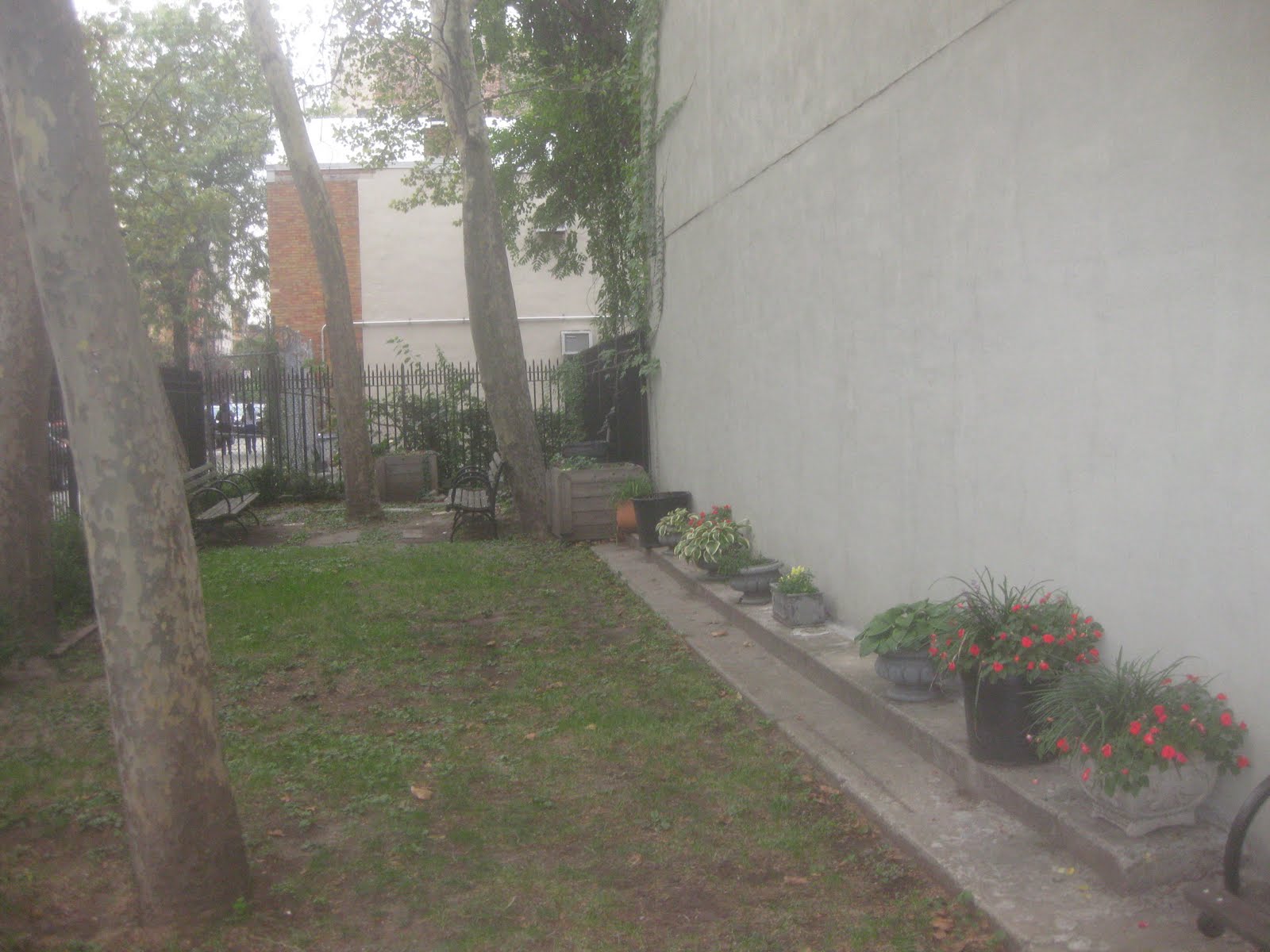
Collyer Brothers Park on 128th Street and 5th Avenue.
A footpath inside the park.
Inside the park, looking east.
Inside the park, looking west.
Another shot, looking west.

The park sign with city park rules and regulations.
The park, on the site of the Collyer Brothers' mansion on the northwest corner of 128th and 5th.
Homer and Langley Collyer were very odd brothers. Their eccentricities, such as compulsive hoarding, anti-social behavior and their filthy lifestyle in the expensive mansion they inherited after their parents sudden departure, have a special place in off-beat New York City history to this day. Many New Yorkers don't agree that they deserve to have a city park named after them just because it used to be the location of the house where they hoarded junk and garbage and eventually accidentally killed themselves in. After all, they were only a nuisance to the community, and the feeling was mutual.

Their father was a bit strange himself. A doctor at Bellevue, he would take a personal row boat out on the East River when called to work at the hospitals on Blackwell Island (now Roosevelt Island), and could be seen carrying it home after he returned to Manhattan. When he abruptly abandoned them and moved to West 77th Street (maybe with their mother, but it is not clear), the life-long bachelor brothers, who had degrees in engineering and law from Columbia University, began a decades-long commitment to reclusiveness that involved collecting piles of garbage and junk that they found interesting and wanted to tinker with, and walking around the city for miles at night looking for food in garbage cans and leftovers that butcher shops and groceries were going to throw out. Langley reportedly walked as far as Williamsburg, Brooklyn, for a loaf of bread.

Despite living like they were poor, when cops kicked down their door for neglecting to pay the mortgage on the house, Langley handed over a check for $6,500 (equivalent to about $88,000 today), and paid the mortgage in full, proving that they actually did have a pile of money. From then on, they asked to be completely left alone, other than to occasionally complain to police about burglars or disruptive kids.

By spring of 1947, neighbors started complaining about the stench coming from the house, and a police crackdown found the older brother, Homer, who had long been blind and paralyzed, dead and hunched over in a chair he'd probably been sitting in for years, his head touching his knees. Langley, the younger brother, it seemed, had disappeared. First a misleading call that someone spotted him on a bus to Atlantic City, and then leads that took the police to nine different states turned up nothing, until a sanitation worker found him a few days later buried in old newspapers and a booby-trap he had concocted, only a few feet from his brother. His body had been decomposing and was being eaten by rats, and the stench that neighbors complained about clearly came from him. He had been crushed by piles of junk and newspapers while trying to bring his brother food. His helpless brother starved to death a few days later. The piles of newspapers, stacked to the ceiling in every room, made it almost impossible for police to get inside. Langley, who fancied himself an amateur inventor and scientist, had been working on a concoction that would, he claimed, one day restore his brother's eyesight, and he was saving all those old papers so that, when that day came, his brother could catch up on the news.

Anyway, it's a pretty weird story. It kind of sounds like something out of an Alfred Hitchcock movie, but it really did happen on the northwest corner of 128th Street and 5th Avenue, and I decide I ought to go take a few pics of the little resting area that sits there now in their honor. I've got to admit, Collyer Brothers Park is actually very nice, and if I didn't live so far away, I could see myself spending a lot of time there. A few benches are set up with a couple of small gardens, and a stone walkway. On this warm end-of-summer day, the flowers, grass and trees were lush and in full bloom, and it was a very nice contrast from the harsh concrete Harlem streets surrounding it. On the fence by the entrance was a community bulletin board, with info posted on when and where the next Harlem Community Board meeting was and other neighborhood events. It seems to me that these brothers didn't have to do much to have a very peaceful and important park named after them.

There were a couple of other pics I wanted to get for the Facebook page while I was this far uptown before the sun went down (the Tomb of the Amiable Child, the Seinfeld diner), so I kept on walking and left the very relaxing and refreshing Collyer Brothers Park for another day.