Showing posts with label Mae West. Show all posts

Sunday, July 10, 2011

The Jefferson Market Library

The Jefferson Market Library today.
The Jefferson Market Courthouse and the Women's House of Detention in the '40s.
The 6th Avenue elevated line in front of the courthouse in the '30s.
Walking along lower Sixth Avenue, it's hard to miss the striking Jefferson Market Library and Garden, at the intersection of West 10th Street and 6th Avenue, a masterpiece in architecture built from 1873-7 that has just recently reopened after some renovations inside, but is still covered in scaffolding.  Walking down there to take a few pictures, I saw it was open for business again and took a look around inside.  The building really is a work of art, inside and out, and as I walked up the spiral staircase to the upper floors I saw inscribed on the circular wall quotes about justice and the law written in intricate gothic lettering.  On the upper and ground floors are ornately carved wooden entrances.  What's now the children's book room, with picture books, a group reading area and computers for teens only, were once the police courts where sensational trials of the likes of Henry K. Thaw and Mae West were held in the early twentieth century; Thaw for the murder of his wife's former lover, architect Stanford White, West for obscenity.  In the basement, there are a couple of arched castle-like entranceways to the former civil court, where the adult computers  and periodicals are.  Sherlock Holmes did his research down there in 1971's "They Might Be Giants".

Several merchants' sheds were set up on the land in 1832, along with the Jefferson Market Assembly Rooms that held trials, named for the late President, and, the following year, a large, octagon-shaped wooden fire tower in the center of the triangular plot formed by the intersection of West 10th Street, 6th and Greenwich Avenues.  Remaining for only a few decades, in 1873 new red-brick, richly decorated victorian structures began to be built in it's place, completed in ten years.  Of the nicely matching picturesque group that consisted of a courthouse, jail and merchants' sheds, only the courthouse remains.  The new, imposing tower and surrounding buildings were based on Neuschwanstein Castle in Bavaria, built for King Ludwig II from 1869 to 1886.  (Only a few blocks away, oddly enough, on the southeast corner of 17th and 7th, directly across from a bank I used to always go to when I worked at Alger, was the last home of Lola Montez, who's catch-phrase inspired the song "Whatever Lola Wants, Lola Gets".  She was Ludwig II's grandfather's mistress and was once made a countess, but died on that corner in poverty in 1861.)  The old jail was torn down by the end of the 1920s, and with Art Deco masterpieces such as the Chrysler and Empire State Buildings, a new Art Deco-style female prison, the Women's House of Detention, went up in 1932.  Supposedly, it was the only Art Deco prison ever built, and with it's walls and windows close to street level, the female prisoners could easily heckle passers-by.  Ruth E. Collins, the prison's first warden, called the completion of the structure "a new era in penology", and believed firmly in rehabilitation as well as punishment, and treating the women with dignity and as individuals.  She commissioned a number of works of art, most famously Lucienne Blotch's mural "Cycle of a Woman's Life from Childhood to Womanhood".  David Duchovny's directorial and writing debut, House of D, about his childhood growing up in Greenwich Village in the 1970s, is named for the prison and features it prominently.

Despite Collins' philosophy, the prison became notorious in it's final years over allegations of racial discrimination, abuse and mistreatment.  Black activist Angela Davis was outspoken about the cruel treatment she witnessed, and anti-porn feminist Angela Dworkin testified that she was assaulted by two doctors there.

The courthouse had it's last trial in 1945 and sat vacant until the late '60s, when it was slated for demolition, while contractors such as Robert Moses planned to build apartments there.  However, preservationist and Greenwich Village resident Margot Gayle enlisted the help of writer E.E. Cummings and historian Lewis Mumford and successfully persuaded the city to preserve the building and reuse it as a branch of the New York Public Library.

Instead of the courthouse, the prison, along with the famous mural was destroyed in 1974, mainly due to the bad reputation it had gained in its final years.  In its place a peaceful, well-cared-for park and garden was planted by community residents.  With benches, lush grass and healthy trees, it is one of the many intimate escapes that speckle the concrete city.  In 1996, after 135 years, the old bell in the clock tower rang out once again, putting, as the New York Times stated, "the 'Village' back in 'Greenwich Village'."  It rings every hour, on the hour, from 9AM to 9PM.

All in all, it's a relief for guys like me who appreciate the lost art form of a bygone era.  What a shame it would have been if this building had actually been demolished.  I walked around the Village a little more, and then headed home.  With Open House New York in November, I'll definitely get an early start to sign-ups and try to catch a more in-depth tour of this place.
Lucienne Blotch's "Cycle of a Woman's Life from Childhood to Adulthood".

Wednesday, June 29, 2011

East 1st Street between 2nd Avenue and the Bowery

The Mars Bar building in the 1910s as the Woolworth Theatre.
The new glass box that stands at the Bowery and E. 1st St. today.

A New York Times article from the 1870s.
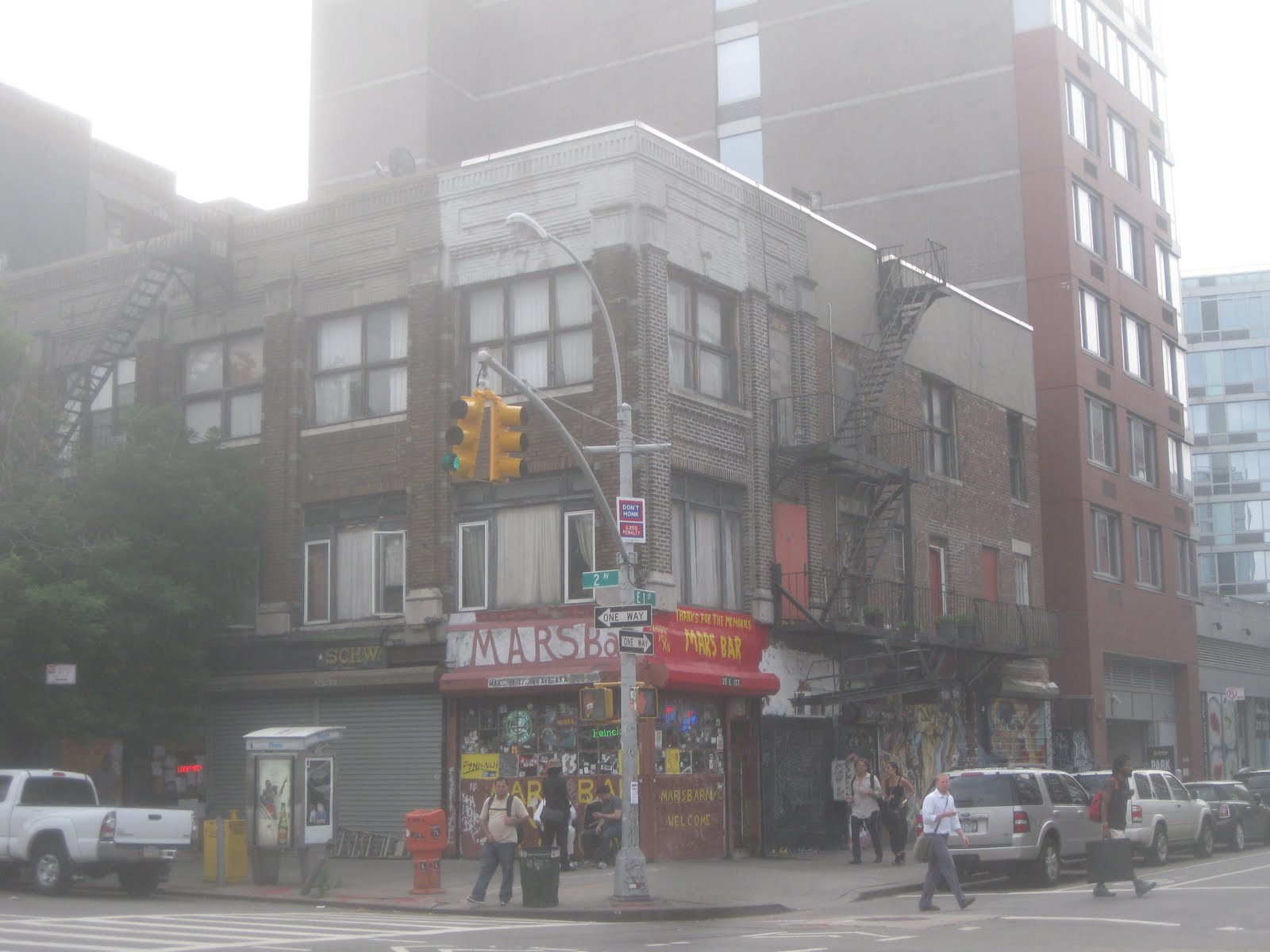
Mars Bar in June 2011.
Another shot of Mars Bar in its final days.
Extra Place in June 2011, undergoing some renovations
The Mars Bar building sat empty toward the end of Prohibition.
Mars Bar in the '40s as a coffee, tea, and spices shop.
295 Bowery, formerly McGurk's, in it's final days.
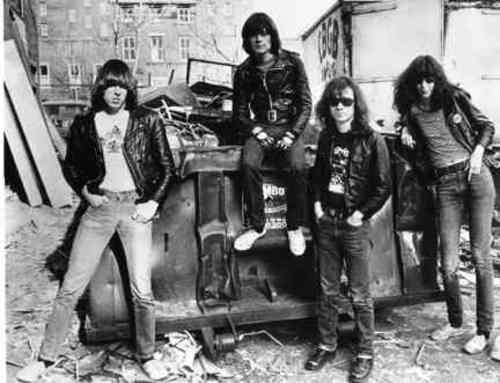
The Ramones pose on Extra Place behind CBGB in the early '70s.
Another description of Extra Place from 1952.
A description of Extra Place from 1952.
Extra Place in 1934.
An 1890s map of E. 1st St. includes "Extra Street".
Extra Place in 1978.
Around the Old-New-York-memory-lane-blogosphere these days, there's been a lot of talk about Extra Place and Mars Bar, old-rocker staples that are drastically changing or being torn down all together, years after beloved CBGB's is long gone. In 2005, historic McGurk's Suicide Hall on the Bowery and East 1st Street was demolished amid protest and replaced with a glass box, and now the same is going to happen with to the buildings on East 1st Street and 2nd Avenue. Anyone who wants to have one last beer at the diviest bar in the city, I read that this is the last week to do it.
Looking down East 1st Street from the Bowery in 2002.

Looking down East 1st Street from 2nd Avenue in 2002.
A close up of 291-295 Bowery, demolished in 2005.
No. 295 Bowery went up shortly after the Civil War ended, where it served as a political and social club for the mostly German community that inhabited the Lower East Side at the time. But throughout the latter half of the 19th Century, the Bowery became increasingly seedier. While the more upscale theatre district could be found on West 23rd Street around the Chelsea Hotel, a less desirable row of opera houses and dance halls lined the Bowery, catering to the poorer lower class. Drinking and prostitution were rampant, and it was common to find sailors and longshoremen frequenting the saloons along this thoroughfare. Back-room girls would hang around these places looking for business. John McGurk, an Irish immigrant who owned a number of saloons in the area, all shut down by police by the early 1890s, took over the bar and hotel at 295 Bowery and immediately started having run-ins with the law. He is said to have had the first bouncer in the city, who was regularly taken-in by police for assault. McGurk's quickly gained a reputation as the seediest, most dangerous hang-out in town, which is saying something for the Bowery. The prostitutes who ended up frequenting this place were very much down on their luck. In 1899, there were at least six suicides and seven attempts by back-room girls here. Some jumped out the windows up above while others drank carbolic acid. One story is of two harlots, Blonde Madge Davenport and Big Mame, who had made a pact to end it. They bought carbolic acid from the local drug store, and while Madge drank her share and suffered an agonizing death, Mame accidentally spilled most of it on her face, horribly disfiguring it. Because of this, she was banned from the bar and thrown out on the street, no longer able to do her job. To bank on his bar's morbid reputation, he renamed it "McGurk's Suicide Hall" in 1901. Unable to fight the constant police crackdowns and owing money to several people, he abandoned the place and fled to California a decade later with his wife and daughter. A final blow came shortly before his death when his daughter was denied admission to a convent school out in California when the nuns learned of the girl's father's history in New York.

In Joseph Mitchell's 1941 essay "A Sporting Man", he interviewed Commodore Dutch, a neighborhood eccentric who decades earlier had gotten his start working for McGurk, bringing sailors and longshoremen there on the weekends. In Mae West's 1932 book Diamond Lil, there's a chapter entitled "Suicide Hall", describing the place. In the 1960s, writer and sculpter Kate Millet and photographer and custom furniture maker Sophie Keir worked there. Despite some protest, the building was unable to get landmark recognition due to its unremarkable architecture and unfortunate if not colorful past, and was demolished in 2005. Next month, the remainder of the buildings that originally made up the German theatre and nightlife scene will be razed as well, and sad to say, I'm sure some giant, expensive, glass hotel will go up in it's place just like one did with McGurk's.

I'm a guy who likes an unpretentious, affordable bar just as much as anyone else, but the first time I took a peak inside Mars Bar, it was almost scary. Talk about a bunch of degenerates and druggies. My cousin who works at a hair salon nearby said she dated someone who loved the place, and there would be people passed out on the floor and in the bathroom. That's why some of the locals are glad to see it go. In a recent article I read, some bartenders said that that place took all the drunks who would be rejected any place else, so all they did was cause trouble. But the buildings that opened up as the Volksgarten and the Steuben House in the 1850's have certainly seen a lot. Called the German Assembly Rooms by the late 1800s, they housed saloons, bowling alleys, and ballrooms. Thanks to the Vanishing New York blog, I've found some great pics of the building: one during Prohibition when it was boarded up and available for lease, and another from the 1940s when it was a coffee, tea, and spices shop. It can also be seen in the opening credits of NYPD Blue (for about a second), and I've added a link. Down with it will also go the locksmith shop next store, whose owner I saw the last time I was down there, but unfortunately only saw him in an online magazine article about a week later.

The glass box on the sight of McGurk's is called "Avalon Bowery Place", and their next project is to turn the easily-missed, yet very-old "Extra Place" into the next yuppified strip-mall, filled with over-priced cafes and boutiques. I had ventured down there a couple of times to see some sort of cafe ready and open for business, tables and chairs out side, and a number of twenty-somethings enjoying the closed-off space and fresh air, but other than that, not too much. The last time I was on the block, it was closed off again -- I guess more gentrification is on its way. The alleyway dates back to about 1800, when landowner Philip Minthorne divided his 110-acre farm equally among nine children. The tiny bit of land that remained was called "Extra Place". The great Vanishing New York blog provided a couple of priceless pictures of Extra Place in the '70s, and a long-lost 1952 interview of a man who worked in a garage that was on the corner at the time. He reminisced about a speakeasy that used to be there that he loved to frequent in the '20s. I also found a great shot of the ally in 1934. Extra Place, in what some would call it's heyday, was the back door of the Palace Bar of the Palace Hotel flophouse, which later became Hilly's on the Bowery, which later became CBGB & OMFUG. Country Blue Grass Blues & Other Music For Uplifting Gourmandizers reluctantly started allowing bands like Blondie and the Ramones to play, and became the birthplace of American punk and New York City cutting-edge Rock & Roll. But as we all know now, it was evicted in October 2006, and replaced by a shoe boutique that sells blank t-shirts for $800.

My plan in the next couple of days is to take a walk down to East 1st Street and walk up and down 2nd Avenue to the Bowery one last time, just to soak up the history, and if they'll let me, get one last beer from Mars (now that I know it's safe, haha). I just want to appreciate the old buildings that are left one last time ... and as for the others, I only wish I had explored down there sooner.